
Minutes earlier, I had been ballroom dancing. But now I was lying down on a grimy floor, evading surveillance and trying to figure out what the hell I was doing. In more ways than one.
For a moment, I thought, “Did I really travel 3,000 miles for this?”
 Let me rewind a bit. A few months ago, I caught wind of a project called The Republic. I read an article that described it as an immersive experience inspired by elements from Greek mythology, Fritz Lang’s Metropolis, and Plato’s Republic. It was described as neither being a haunted house, escape room, nor traditional stage show, with the implied suggestion that it might contain whiffs of each. It even claimed to not be immersive theatre, at least in any sort of comparative sense to anything that’s been done before. The Republic was claiming to be something completely new. I’m so there!
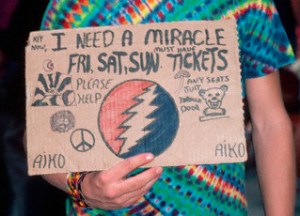 There was just one problem. There was in Florida. It debuted at the Orlando Fringe Theatre Festival, which is nowhere near me. I needed a miracle. I asked the universe, and in reply got an email a few weeks later from a colleague telling me that I needed to go to Orlando for a tradeshow, on my birthday, while The Republic was running. Boom!
 NOTE: the rest of this post does not contain any explicit spoilers, but I do flirt dangerously with disclosing the nature of what happens. If you’re planning on seeing this show, and want a completely pure experience, then you’ve been warned.
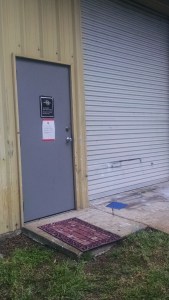
On the day of the show, I received an email directing me to a nondescript warehouse near downtown Orlando. My drive was accented by a torrential downpour complete with Zeus-worthy lightning bolts that seemed somehow appropriate. I’m from California. Weather’s a novelty.
By the time I arrived, a queue of guests had already formed outside the entrance, and we went through the increasingly common waiver signing formality before being allowed to enter. Once inside, we surrendered our cell phones and entered an anteroom where we were provided with a new identity and reminded about the rules of engagement. In short, explore, ask questions, and get involved in the action.
 I am totally fascinated by the idea of immersive theatre. It blends storytelling, technical enhancement, and interactivity in a way that generally doesn’t exist outside the theatrical world except to a limited extent in some theme park and haunted attraction experiences. Ordinarily, attaching a genre to experiences that are attempting something groundbreaking is a restrictive and empty exercise, but it can still provide some useful context. As a baseline most productions tend to interpret it as a theatrical experience without chairs. The idea is that the elimination of the construct between the audience and the players allows for a deeper level of involvement with the drama. When it works, it can be tremendously effective. When it doesn’t, it might make you wish you had your chair back.
… if you want to
More ambitious productions add a layer of multiple rooms and encourage guests to do a certain amount of free roaming. In theory, the drama can potentially branch in multiple directions causing you to choose a single narrative thread at a time to follow. Some productions go even further by requiring guests to participate in the action by carrying props and executing other simple, scripted interactions.
In these types of shows, guests may have dramatically different experiences depending on the decisions they make, and may feel like they’re attending a totally different show upon repeat viewings. However, the net effect is really a partial glimpse of what is essentially a larger static narrative. The Republic does all of these things, but they’re just getting started.

Game Over Man
What makes The Republic different is that each guest is required to play an active role that has the potential to redirect the outcome of the narrative. This is a pretty giant step forward from simply being up close and personal to the action. The creators compare their show to a video game, and this shared sense of agency is at the heart of it.
When the show began, we were told that we were recruits, and in the first “scene,” each guest was assigned to one of the cast members who would be training and evaluating us for inclusion within the Republic. I had been concerned about the emphasis on role playing, but the role of a trainee was easily accessible even if the context was essentially bizarre and cryptic.
 Early on, I was given a task to surreptitiously hide a folded-up note in a separate room. The room itself was a dead end, so I couldn’t go off on a tangent of wild exploration, but it did allow me to be alone for a brief moment. It may seem obvious, but I realized that I had been presented with an unspoken choice on whether to read the note before hiding it.
I decided to read it, and I was conscious of the time it was taking me to read it, since I was only supposed to be hiding it. Once I returned, it did not feel like an appropriately confidential time to discuss what I had read. The fact that I had read the note at all may have suggested that I had betrayed a certain confidence. The character who handed me the note did not ask me whether I had read it. I was completely in my own head over this one simple task, but I was digging it. This was immersive and exciting!
 In a subsequent scene, when I was able to get some time alone with my assigned character, I asked him about the note and our conversation yielded a treasure trove of information including many tantalizing new clues and facts to piece together. It made me wonder what would have happened if I hadn’t read the note. What would our conversation have been like? I caught a glimpse of the myriad possibilities and twists and turns, and my experience was just one perspective out of 20+ guests in the context of something that might or might not have happened in the first 5-10 minutes of a 90 minute experience. You’re probably starting to get the idea of how big this thing could be.
 In order to pull something like this off, the creators would have had to essentially create an all-encompassing universe that could account for dozens of permutations that could be communicated, interpreted, and executed on the fly on a minute-by-minute basis by actors who are basically improvising almost 100% of the time. It’s like a single game of Dungeons & Dragons with 20 Dungeon Masters and 20 players, played in 20 different rooms all at the same time with frequent reshuffling of all components. That’s huge. Like head-spinningly crazy. Which is probably why it ultimately didn’t totally work. For me at least.
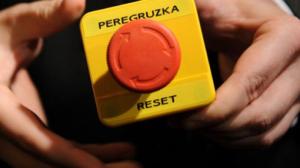 If I had to theoretically reverse-engineer this beast, the principal challenge becomes how to reconcile what could easily become a freeform exploration of chaos theory. Periodically, there seemed to be narrative inflection points, roughly occurring at the end of an “act” in theatrical parlance, although that ship sailed long ago. These moments temporarily aggregated all the players in a single room and forced various narrative threads into some form of interim resolution. Think of it as a metaphorical reset button that attempted to contain the rapidly spiraling madness.
In theory, this is a clever mechanism. In practice, I personally felt somewhat more unmoored each time until I felt utterly disconnected from the show. The story might have been reconciled, but my role in it usually became less clear. Unfortunately, that tended to create something of a vicious cycle for me: the further I felt from the momentum of the story, the harder it was for me to jump back on the merry-go-round. I’m willing to share some of the blame for this for not trying hard enough to engage or re-engage, and at some point, I must have hit a personal limit. Or maybe the heat inside that warehouse had finally scrambled my brains out of my ears. There were no mirrors so I couldn’t be sure.
So did I like it? Well, it’s complicated. It’s important to remember that this debuted at a Fringe Theatre festival that provides a “safe” place to try out all kinds of crazy stuff that would be skewered in the context of the traditional stage scene. Not all of it is going to work. And when it does work, as it did for me in the initial scenes, it was stunning.
 I give this team a ton of credit for creating this thing in the first place. I can imagine the B.S. sessions where people were saying, “What if we riffed on Plato’s Republic and inserted a bunch of characters from Greek mythology and rendered them against a German Expressionist backdrop and involved the audience, but totally let them feel like they were directing the action so that we’d basically be improvising 100% of the time so that each night we’d basically be putting on a new show.” Believe it or not, people have these kinds of crazy ideas fairly often. However, it’s a small handful who have the balls to actually follow through and try to raise the money, develop the concept, find the space, build the team, train the actors, build the set, and the hundred other things needed to bring this fully-grown Hydra to life.
To Team Republic: Thank you for having the courage to try something so audacious.
I find myself continuing to think about it. I honestly think that the creators should launch an online message board that could be like a support group for guests to share their experiences and riff on theories. There’s a lot going on here.
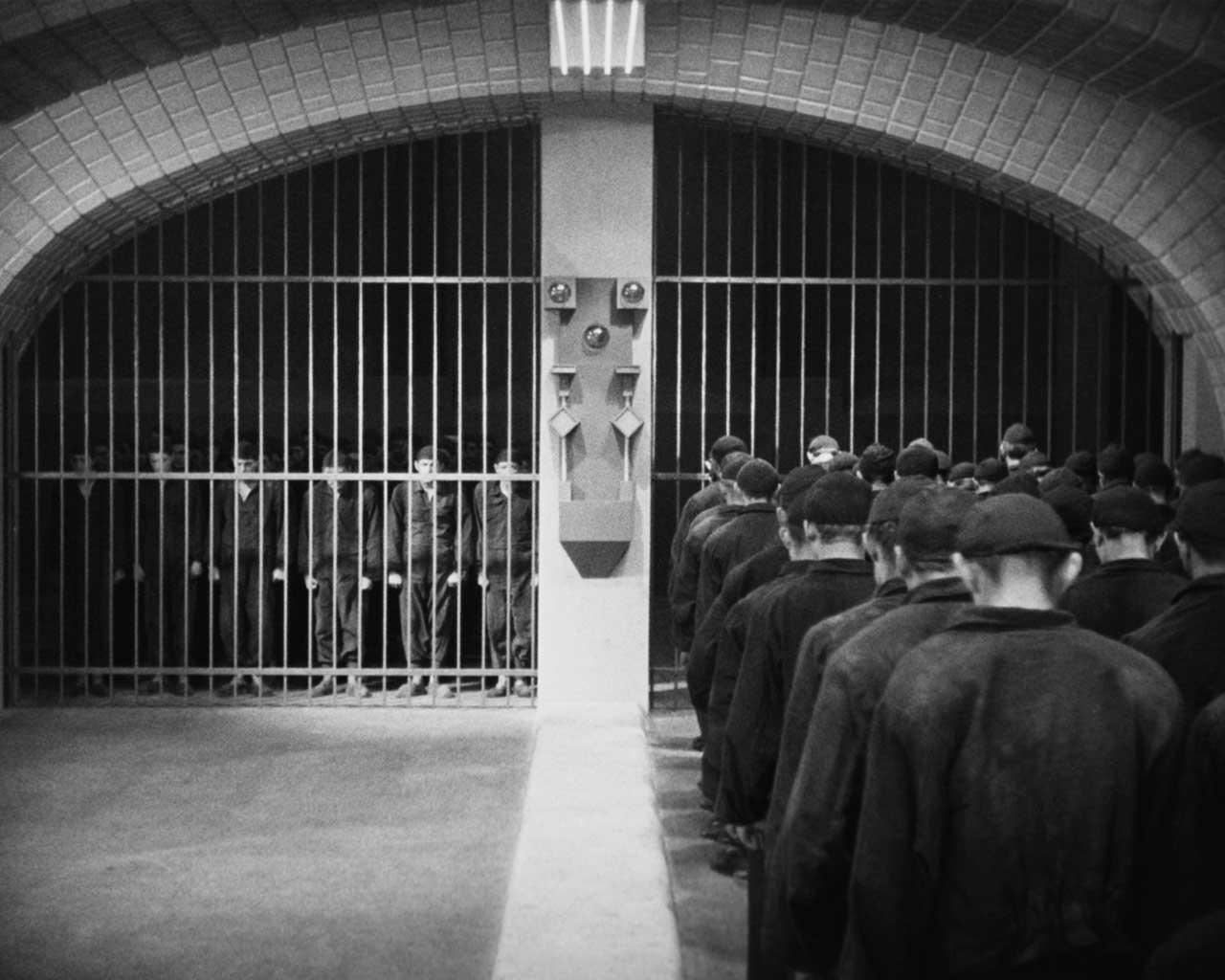 But the final test of whether this thing worked — I would probably see it again. Now that I have a handle on what’s going on and how it works, I’d do some things differently. I’d be curious to further test my own boundaries as a guest. I’d want to see the rooms I probably never got to see, and interact with characters that I only saw in passing. It felt like a world worth returning to, although I’m pretty sure I wouldn’t want to live there.
 “Are you ready to save the f–king world?” he asked. To be honest, it was a bit more than I had in mind after a day at work, but I exchanged looks with my companions and said, “Sure!” After all, what could possibly go wrong?
 So, back to saving the world. In the real world, we were at the Brewery Arts Complex, an artist colony housed in a former brewery that is off the beaten path in an industrial part of Los Angeles. It’s an easy place to get lost in and quite mysterious in its own right. Certainly worth saving.
 However, if you’ve read their website, you’re probably wondering, is this an escape room attraction? If you haven’t experienced one, escape rooms are pretty much what they sound like: you’re placed in a locked room and have to figure out how to get out, usually within a fixed time limit. And there’s no guarantee that you will. Getting out usually requires solving a number of puzzles based on objects in your environment, while possibly fending off antagonistic or distracting elements. I had a tremendous time at last year’s
  Story Room shares many of the game mechanics and sensibilities of an escape room, but the narrative framework substitutes progress for escape. It’s a subtle nuance, and therein lies all the difference.
 As a practical illustration: we did OK with the puzzles, but we were occasionally assisted via a mechanism that was integrated with the story. Sure, my ego would have been more gratified if we had performed better, but I found myself less focused on winning or losing and far more interested in what would happen next.
 The website boldly namechecks the Choose Your Own Adventure book series from the 80s & 90s. This type of branching narrative is a holy grail of sorts for experience designers in location-based entertainment, but can be operationally difficult to execute. It seems that on some level, even if we didn’t experience all the possible outcomes, they pulled it off.
 We were in there slightly over an hour, but time flies, as the saying goes. Understanding that like any production, they are limited by real resources such as budget and space, my main feedback for future productions would be to create more “scenes” even if each is shorter. Reflecting on how this show redraws the line between storytelling and problem-solving, I would love to see them take it even further and incorporate more branching, more rooms, and maybe even some live performers. In other words, more of everything that worked so well.
 he Purge last week. OK, that came out weird, let me explain.
 The typical haunted attraction tends to be a fairly linear affair. You start at the beginning and keep moving until you get to the end, trying to absorb or avoid (depending on your preference) as many scares as you can along the way. In contrast, Breakout is billed as “An Immersive Escape Experience.” Groups of up to six guests are locked into the attraction at one time and given thirty minutes to try to figure out how to get out by deciphering clues and solving puzzles that are embedded in the surroundings. The concept of an Escape Room attraction is not new, and did not originate as a horror-themed show, but as
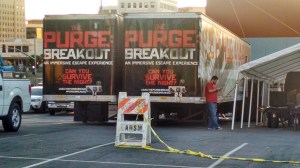
 We solved a bunch of puzzles. We tried our hardest. We celebrated our successes. But in the end, we died. Murdered to be exact. Time ran out, and for us, it just wasn’t enough. If we had five more minutes! If we had only done such-and-such! Did we remember to look behind that one thing? We wallowed in the coulda-woulda-shouldas for a minute or two, but the general consensus from all of us was, “That was SUPER FUN!”
 I was in awe at how naturally we worked together as a team, despite the fact that we barely knew each other. People’s strengths immediately surfaced — the codebreakers, the searchers, the observers, the scouts — without any explicit coordination. Almost all of the puzzles required some form of cooperation, but it somehow happened in a seamless way. When it was all over with, we felt like old friends, and made plans to get together for future events once October rolls around. It was magical.
 I lived in Prague during a period when email was still a novelty, mobile phones were seen in Tom Cruise movies as devices used for making phone calls, and internet cafes actually had computers in them. A popular means for distributing information was known as a “newspaper,” and a few were published in English for the benefit of the expat community. One of these featured a column called, “Easy Targets,” which was an unannotated list of people, institutions, concepts, etc. that would be recognizable to a contemporary reader. And that was it. Further commentary was neither provided nor required. A similar list published today might include, “Congress, Miley Cyrus, Facebook status, gluten-free beer, you get the idea.” One fateful afternoon, I picked up said newspaper and immediately sought out the Easy Targets, and at the top of the list was, “Smažený Syr.” For me, this was and is the absolute soul of wit. There is so much depth and commentary packed into those two words that it can still bring a smile to my face today. Let me explain.



 Out of respect for the organizers, I won’t give up any spoilers, but I will share some general impressions. Admission can be purchased on a per attraction basis. I was here from California and was in the middle of nowhere, GA. I was going to all three.

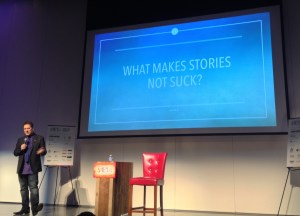



 In short, stories that do not have a deeply immersive component must suspend disbelief so that you can accept the story that is being told to you. On the other hand, immersive experiences must suspend disbelief so that you can accept the story that you end up telling yourself. This is a key insight for me as a storyteller. As a writer and filmmaker, I recognize that I often try to direct and control my audience’s reactions. For instance, I might evaluate the success of my piece based on how many people laugh or jump or cry at specific points that I have crafted. However, as an experience designer, that approach might not be ideal. A successfully designed experience may encourage a viewer to integrate what she is experiencing in a very personal way and with a highly individual outcome. To paraphrase Asa Kalama, another speaker at SATE’s story segment, sometimes the most effective approach in developing a successful experience may lie in providing a compelling framework for a guest’s creativity to blossom, and then getting out of the way!
 The Memelab