
 The truth is, I only had a dim idea of where I was going or what to expect. A couple of days earlier, I received an email from “The Society” inviting me to observe some of its members engaging in their spiritual practices “within the hideaway of nature itself.” The email connected me to a short form, which among other questions asked if I would be available and bodily capable for a reasonably long hike early on Saturday morning. That Friday, I received a follow-up email with detailed instructions on where and when to show up, and what to do once I got there, noting that this particular time was unique to me, presumably to ensure a more reflective and individualized experience.
The show was called Babalon, and I was marginally familiar with The Society as a group that mounted some shows in LA’s dynamic immersive theater scene a couple of years ago, and was often mentioned along with other shows with a horror/haunted theme. However, as I’ve noted elsewhere, some of the techniques that have been refined in horror-themed shows have cross-pollinated into immersive shows across a variety of themes: small group or solo experiences, “secret” venues, personalized interactions with cast — all contributing an experiential intensity that may be unrelated to fear.
So there I was Saturday morning, packing a water bottle, an energy bar, applying sunscreen, and reviewing the pages of photo references and detailed instructions so that I could . . . go to a show.
The trailhead was busy; it was after all a beautiful summer morning in Los Angeles. I savored the dissonance of attending an event alongside a sizable group of people, who were actually not attending the same event as me, or at least I didn’t think they were. In fact, it was not possible to know with any certainty.
 However, as is common with hiking trails, once my journey was underway, I soon found myself quite alone, save for the occasional courtesies to passed and passers-by. As I walked, I wondered: were they heading to/from my destination? Were they in the know? Initiated? Transformed? Enlightened? Before I knew it, without a single performer or setpiece that I could confidently identify, I was very much in a show that was possibly entirely in my own head.
The instructions advised that it would be about 2.5 miles and about 50 minutes to reach my destination. As I had committed the location of the trailhead to memory, I didn’t burden myself with any hard copies of the actual trail map. So, when I reached some unexpected forks in the path, I used my best judgment and hoped that I had chosen correctly — which seemed appropriately metaphorical for an experience about a group of seekers who have returned to nature to discover a more enlightened path.
 As I approached the destination about an hour later, it took me some time to locate the “guide” who I had been directed to find. She was quite literally off the beaten path, although in retrospect I realize that I had completely missed some subtle waypoint clues that had been hidden in plain sight. I had arrived, hot, sweaty, wondering if I had brought enough water, and with my curiosity and sense of accomplishment quite intact.
The first moments of any performance are critical. At this point, you and the show’s performers and creators must quickly reach an unspoken accord to suspend disbelief and go on a journey together. In immersive theater, the stakes can be even higher, because audience members need to literally enter the story and stay in it in order for it to work. It can be a big ask, and even the most willing of participants may “fall out” of the moment, or simply never fully arrive.
So it was a clever set-up that the guide presented herself as a down-to-earth, relatively grounded individual, who had left her unfulfilling corporate job to help The Society with their public image. It was a relatable, contemporary backstory that was a good fit for Los Angeles in 2019. It seemed entirely possible that I had actually been invited to a semi-clandestine gathering of an eccentric group in the middle of the woods, who had chosen to make a public display of their beliefs for all to see.
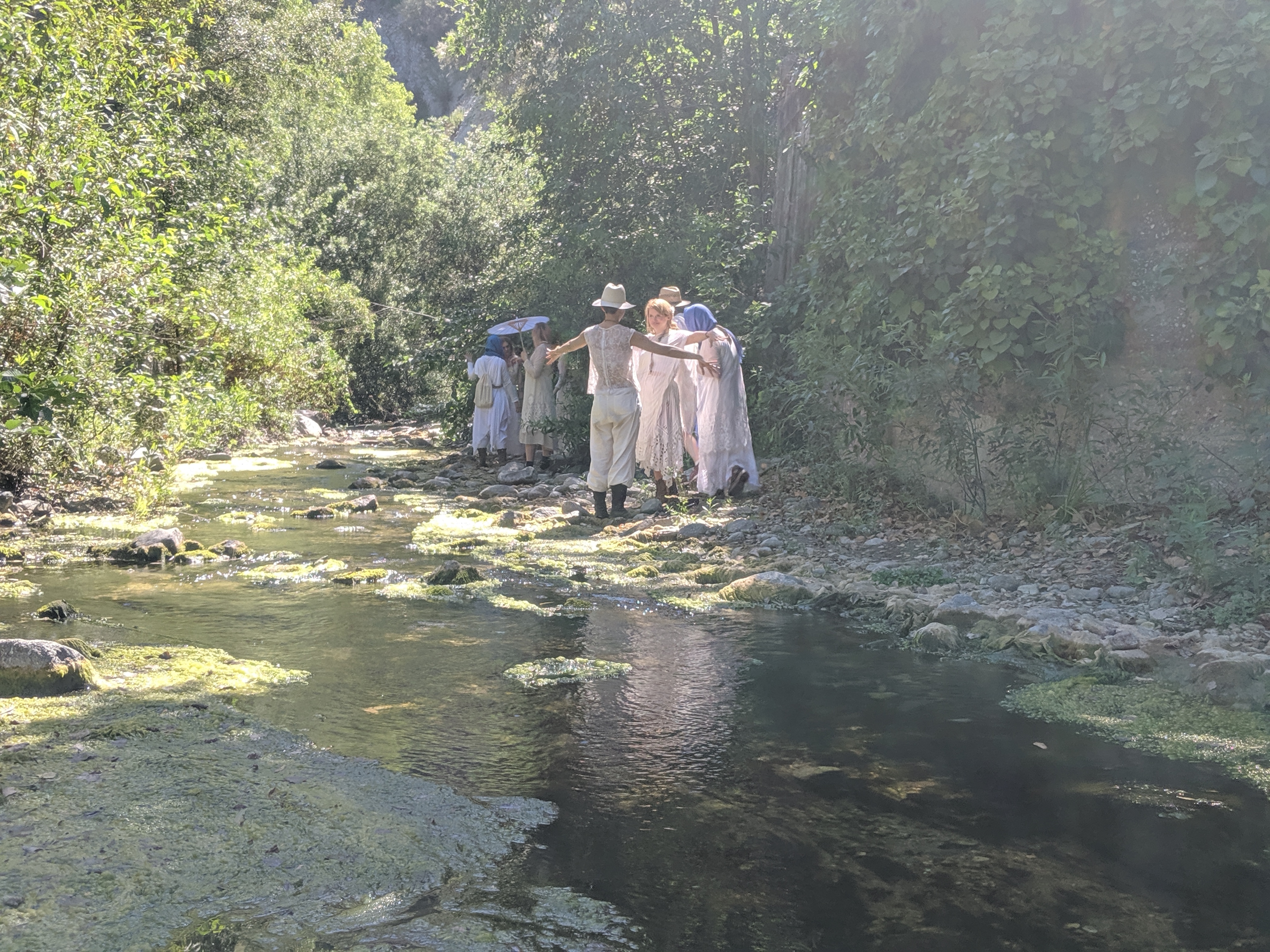 The guide shared some standard house rules: observe, don’t interfere, etc., and noted that I could stay and watch as long as I wanted from a variety of vantage points. What I found waiting for me was a group of women, frolicking in a creek-bed, consumed by a flow of hypnotic dancing and chanting, and dressed in airy attire that varied between ritualistic and fairylike. If you’ve ever seen the movie Picnic at Hanging Rock, a personal favorite (the original Peter Weir masterpiece, not the deplorable Amazon Prime debacle) then you’d have a decent approximation of what was unfolding.
I meandered and watched and listened and sought to tease out some sense or pattern to the endlessly unfolding ceremony. It was maybe more anthropology than theater, and with no clear start or finish, my eventual disengagement from any expectation of an outcome was its own reward. It was like a waking dream, an explosion of the sublime on the outskirts of the profane. When I had observed to my seeking soul’s content, I began the 2.5 mile journey back. Along the way, I had a lot of time to think about what I had done, seen, and was doing. The show was over (I think.) But I was still in the show.
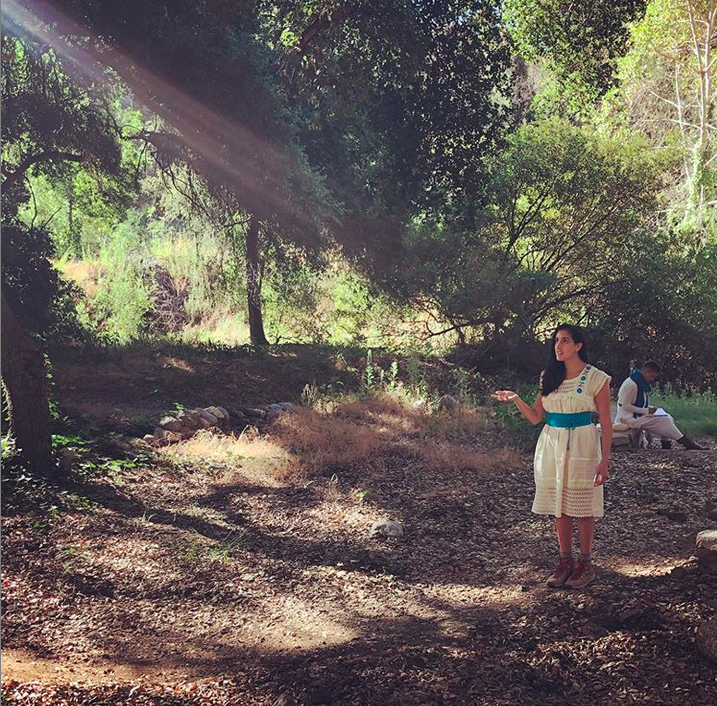 In addition to being intrigued by the potential of its storyline, I thought about how this show fit into the broader world of experience design. I reflected on the interplay between what had been directly produced as part of the show, what had been incidentally provided as part of the public location, and what I had personally brought to the experience. If I had merely seen the same “content” at a “normal” venue, would I have been affected as deeply? Of course the answer is no, and of course this isn’t news, because context differentiates themed entertainment and immersive theater from many other entertainment experiences.
Most immersive experiences, no matter how diverse, share a simple but common framework of:
- guest arrives
- show starts
- guest becomes part of the show
- show ends
- guest leaves
 This works really well for shows of all shapes and sizes, and in most cases, each of the bullet-points above, except for “the show,” are generally taken for granted. But Babalon exploded and blurred the lines between each of these phases. When did I really arrive? When did the show start? When did it end? This already sent my mind wandering in all kinds of wonderful directions, but what really struck me was how the five miles of walking factored into all of this, and how that might have been Babalon’s true stroke of brilliance.
Babalon embedded the actual show at the centerpoint of a hike: a meta-experience that served the functional requirement of providing access to the show, while also serving as a powerful metaphor for the theme of personal journey. It was the duration of the hike though that made me realize that merely attending the show required me to make a meaningful personal investment as a guest and unexpectedly enhanced the overall experience.
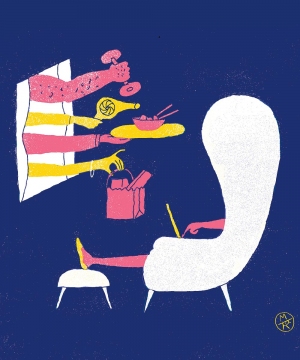 We increasingly live in an on-demand world, especially with regard to entertainment options. We can see, hear, listen, read almost anything we want, whenever we want, wherever we want. That was not the world I was born into, and I’m not that old. My kids may never know the thrill of scouring the imports bin at a music store for an elusive B-side. Or the triumph of finding that out-of-print novel at the 4th used book store visited that day. Or driving an extra ten miles to that one video rental store that has the trippy arthouse films. Even live entertainment has been similarly streamlined. No more camping outside the record store to be first in line to get a coveted concert ticket. You can call me a foolish romantic, but there are tracks, books, flicks, and tix in my past that mean all that much more to me because of what I needed to do to get them.
I don’t mourn the march of progress, but that doesn’t mean that I don’t celebrate the opportunities to slip between the cracks. As creators, we should not shy away from asking more from our audiences. And as audiences, we should be looking for ways to put more of ourselves into the shows. If a creator can inspire me to literally or figuratively go the extra mile, and if my effort translates to a more personally meaningful experience, then I’m ready to show up.
 n other words, these experiences are likely to be more sophisticated and immersive than what is available with a typical home-based setup.
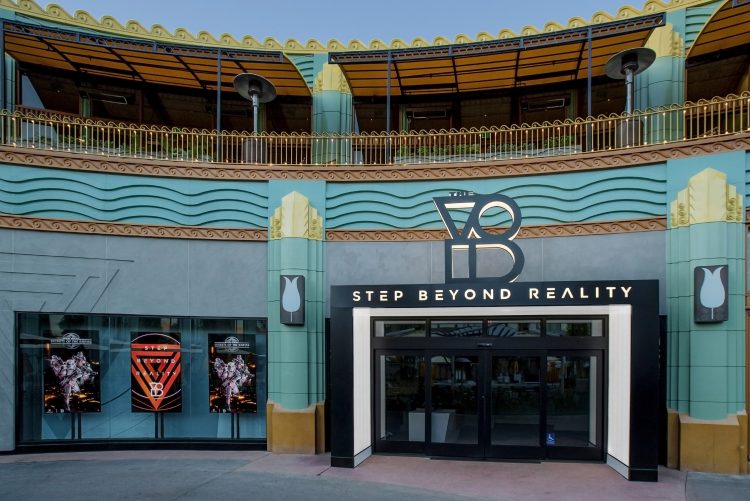 STAR WARS: At the Downtown Disney location, the exterior theming and signage is primarily oriented on letting you know that you’re at THE VOID — the company that produced the experience. A few Star Wars display window graphics hint at what’s inside, but the lobby is similarly VOID-oriented. Overall, I was picking up on a multiplex design sensibility that enforces a clear distinction between the framing experience of the hosting facility and the show itself. I didn’t really think too much about this until I saw . . . .
 ALIEN: The experience and storytelling begins with exterior theming that features large-scale graphics that make you feel like you’re entering a futuristic outpost. The story continues inside where dark, moody lighting and sound effects, impressive set-pieces and wall graphics, costumed attendants, and even a full-sized Alien sculpture set the stage for deep-space adventure. It was fantastic to feel like a part of the story from the second I walked in.
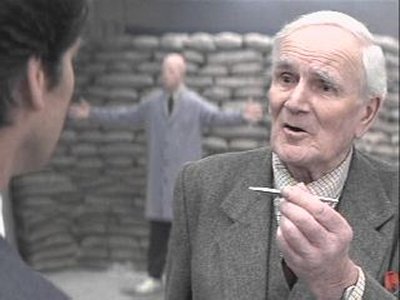 2. Q-Factor: As much as these experiences should be about immersive storytelling and transparent technology, there is an undeniable Bond-esque gadget fetish that temporarily takes over when you’re gearing up for your mission.
 ALIEN: Fans and heaters were also in play, and floor haptics were used to drive epic “elevator” experiences that powerfully enhanced the visual design by creating the sense that you were moving through outrageously large volumes of space. There were also some rickety floor surfaces that added to the tactile sense of environment.
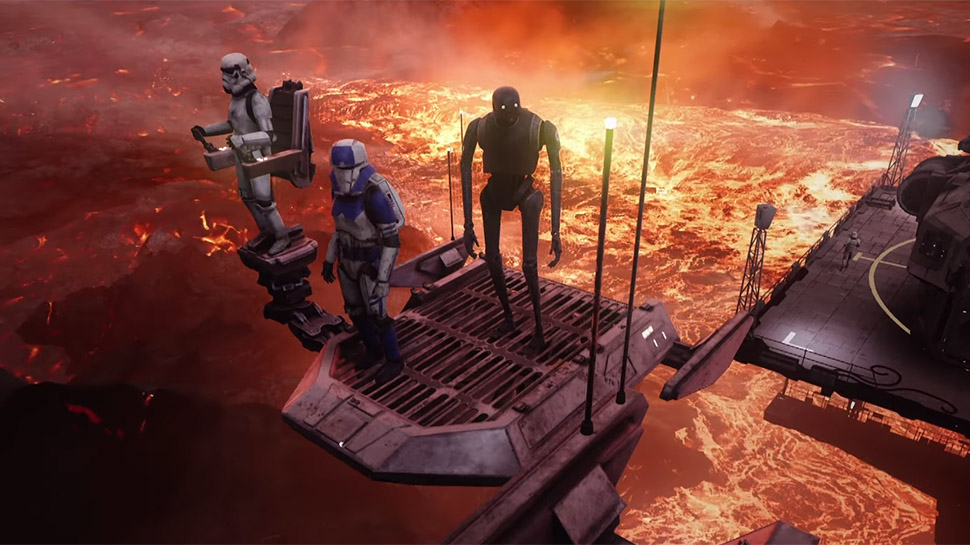 STAR WARS: This experience was full of surprises and moved you through lots of different environments from the inside of a transport ship to the surface of Mustafar to multiple levels of an Imperial base. There was an exciting sense of discovery and it was not easy to keep track of where you might actually be in real space, nor would you ever really want to, unless you’re a geek who can’t help trying to reverse engineer these experiences. The variety of locations is enriched by gorgeously rendered visual details that make you feel like you’re living the ultimate fan dream of walking through a Star Wars movie.
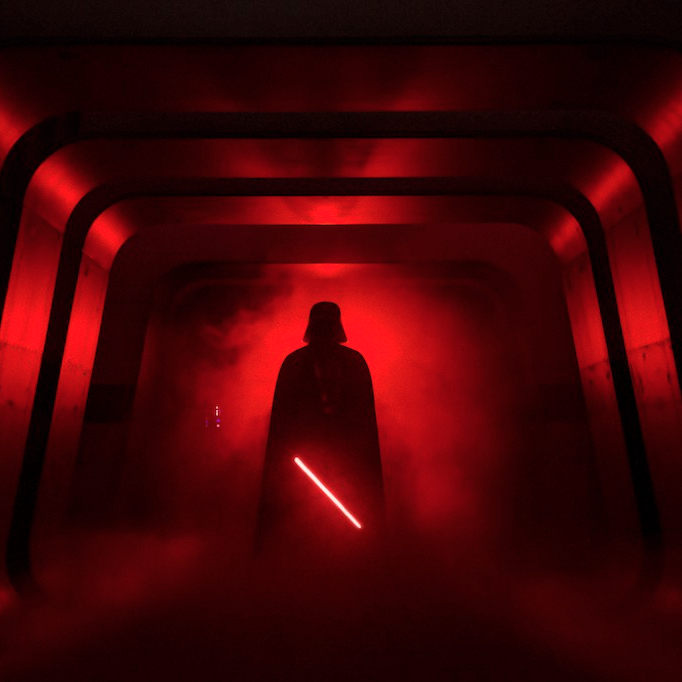 STAR WARS: A video preshow provides a mission briefing about retrieving a powerful weapon that has fallen into the hands of the Empire. Your mission is to infiltrate the Imperial base while disguised as a stormtrooper. The story continues to be developed through non-player characters that provide additional information and react to your presence. As the experience unfolds, you acquire a blaster, so that you can . . . react back. Once shooting ensues, story goes somewhat by the wayside. In the climactic scene, we come face-to-face with Darth Vader who is throwing down some of that nasty lightsaber fu that was notably featured in Rogue One. There’s a surprising twist in this scene that ultimately provides a satisfactory resolution to the narrative.
 ALIEN: A video preshow prepares you for transport to an alien-infested mining station with the mission of rescuing survivors. This is probably incredibly subjective, but this felt like a cleaner, more direct in media res setup that fine-tuned my sense of agency in the experience from the get-go. The story is skillfully communicated in a visceral, mostly non-verbal way resulting in a more organic narrative of exploration as opposed to moving through a linear series of staged scenes. It was refreshing to live the story rather than be told the story.
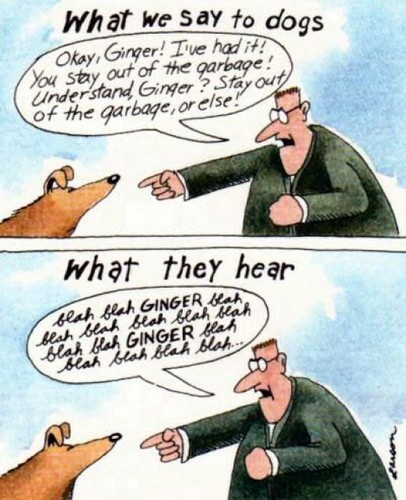 Interactivity: Arguably, the most compelling opportunity for this type of entertainment is providing guests with the ability to engage and affect both the environment and other players. In both experiences, a good portion of the interactivity involves shooting stuff. While attractions that feature shooting can be incredibly fun, even just holding a gun can be highly distracting and can make it hard to focus on other details. Both experiences seemed aware of this and handled it in different ways.
 ALIEN: Let’s be honest. This one is mostly about the shooting, but oh what delicious shooting. Your gun fires laser bolts as well as grenades, each with its own trigger or button, with different reload periods and damage. The gun also has a laser sight that you can turn on or off (for extra challenge). Just sayin’, it was incredibly satisfying to fire this gun. The vast virtual spaces (see Environment above) for your projectiles to traverse was a major enhancement. Also, because of the way the story is setup and developed, I found myself communicating and interacting more with the other player as we worked together to shoot our way through.
 It’s increasingly common to see “horror” experiences on nearly a year-round basis, but the best work tends to be saved for October. Amidst these high expectations and as a follow-up to last year’s debut, this year’s “signature” show did not disappoint, despite having scant resemblance to anything that had come before it.
 I can remember it so clearly. Parking my car on the unfamiliar suburban street near an address that I had only been provided in the past day. Walking alone up a dark path, carefully following the provided directions to choose the right path at appropriate landmarks, and finally approaching the figure wearing a black robe, standing silently. Waiting for me. And thinking to myself, “Now what?!”
 After Parturition‘s relatively disappointing follow-up to Fear‘s dark splendor, I was wary of Shoshin. From what scant information that was shared beforehand, it seemed to be an immersive theater show about Zen Buddhism. Huh? Exactly. Should I sit this one out? Have these guys gone off the rails? Did I have them all wrong? Was Fear a lucky hit? But it was May; October was months away, and I could hear the darkness calling.
 First, some overall context. Los Angeles continues to be one of the best places to experience what can be loosely described as extreme haunted attractions. Unlike traditional haunted houses which are designed to accommodate hundreds if not thousands of guests per hour, these experiences are designed for smaller groups, and sometimes just individuals. They frequently require you to sign a personal liability waiver that allows them to break down traditional barriers by permitting them to touch you and generally subject you to more bodily intense treatment than would ever be allowed at most theme park events or family-friendly/amateur offerings. I’ve written about some of them before, and when they’re executed well, they can be uniquely thrilling and impactful experiences. I’m not going to beat around the bush,
  5. Parturition (January 2016)
 4. Bardo Thodol (September 2016)
 “What the hell did you just do to me?!” If I hadn’t actually spoken the words aloud, they were certainly running through my head (among other things), but let me set this up for you.
 I also produce interactive experiences. “Interactive” means something different to each person you ask, but I loosely define it as the integration of technology in an environment to extend, enhance, or personalize narrative possibilities. That “anything goes” vibe you’re picking up on is intentional.
 One of the most exciting and challenging phases of the production process is brainstorming with a group of creative people in a relatively untethered fashion. In some of these sessions, where anything is valid and the ideas are crackling with vision and potential, someone may ask me, “Is that doable?” Thankfully, I usually don’t need to have a ready answer in that type of session. At some point the execution of realistic solutions within the pesky limits of time, money, technology, etc., can be a creative art in itself.
 This type of thinking quickly ventures away from the domain of viable experiences and into the realm of science fiction. In other words, it seems unlikely that we’ll get a practical glimpse of this kind of stuff anytime soon.
 He stood in front of me holding a mobile phone, and to the best of my recollection he waved his hand over and across the screen and back, like a fumbling magician doing a trick that everybody knows isn’t going to work. And then he asked,”Did you feel that?”
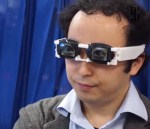
 The device is called Entrim 4D, and it generates a small current that stimulates the vestibular system in a way that mimics the body’s response to actual motion. The purpose of this is to mitigate potential motion sickness caused by VR. Next, I did an actual VR demo of a racing experience, this time with a Gear VR rigged up with Entrim. With each turn of the virtual car, Entrim simulated the corresponding motion in my body, which was somewhat less off-putting since it was supported by the VR visuals.
 A good show takes you on a journey down a path. Technology may play a part in paving the path or shining a light to guide the way. Regardless of the machinery behind the scenes though, creators ultimately provide an imperfect space that can only be completed by the imagination of their guests. There is an unspoken agreement that asserts the integrity of each party and the mutual trust between them.
 By contrast, a technology like Entrim is an override that forces you to feel in a specific way. It removes the question of how it makes you feel, because it no longer needs to ask. While Entrim itself seems relatively harmless, it feels like an early waypoint on a slippery slope that may lead to some version of my sci-fi daydreams of creepy, cyborg technology.
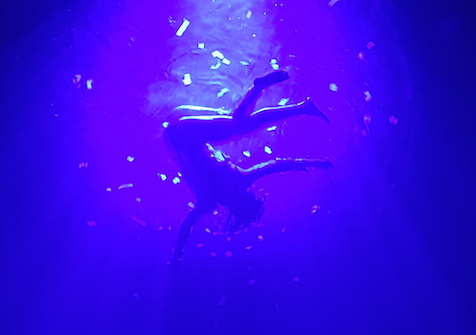 I knew I’d be on my feet and craning my neck, but the reviews failed to mention jaw fatigue from constant droppage.
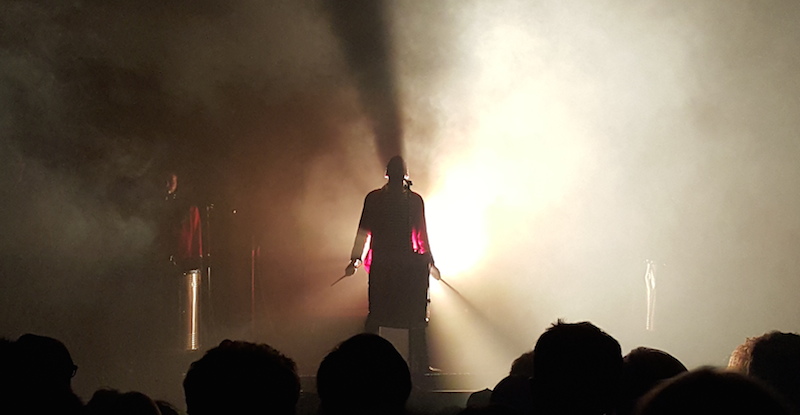 The show is general admission, standing room only in a generally featureless space that could be the Nirvana video without the bleachers. The lights went down and some drummers took the stage and set a tone for the event. The lighting was great, but it wasn’t anything I hadn’t seen before.
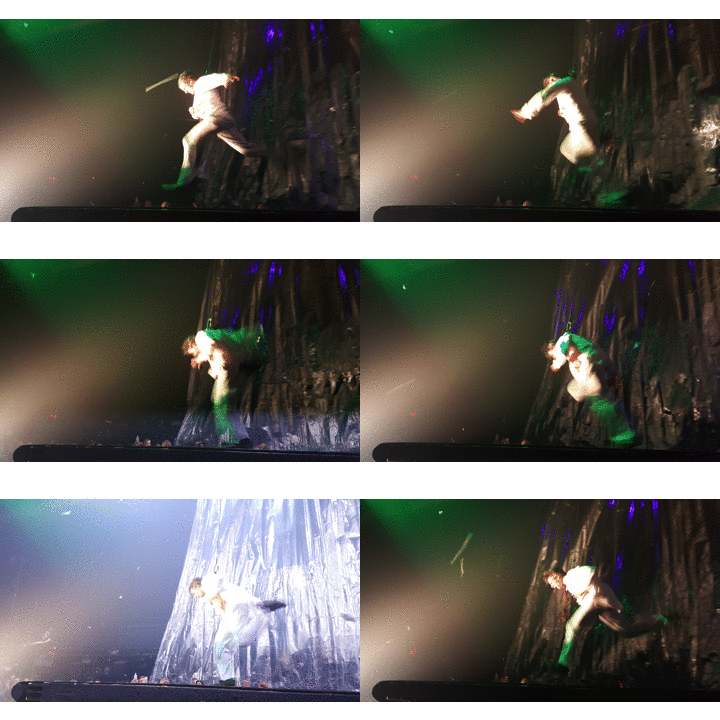 One of the opening vignettes involves a man running on a treadmill wearing nice clothes. He’s running against the wind. This is happening about six feet away from me. Props, chairs, tables, the familiar trappings of life, are placed onto the treadmill and he must avoid them. Other people join him on the treadmill and pass him by. The same people pass him again. The same props. The same situations. Sameness. Struggle. Submission. Time is passing. This is life! This was my life. This is what life was for me before I made some rather large changes. I recognized this and identified with it in a visceral way that cut me to the bone.
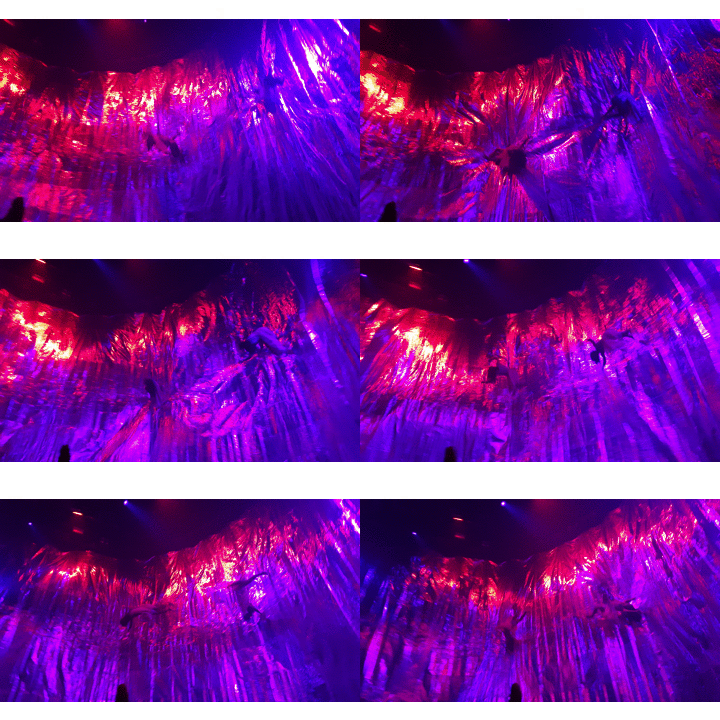 In another scene, performers are running and flipping sideways back and forth along the inside of a cylinder that has been temporarily constructed around the audience. Later, nubile performers slipped and slid through a pool of water hanging above the audience, sometimes suspended low enough so that you could connect, exchange a look, touch a hand through the surface. There are no words, but there is a powerful language of movement, a vocabulary of speed, friction, collision, balance, and it all made perfect sense to me.
 This just shouldn’t be my type of show, but it is. For me, Fuerza Bruta is a powerful expression of what happens when you stare into the blinding sun of possibility. It’s the courage of throwing yourself onto a path of uncertainty. The childlike joy of relearning everything you thought you knew. The ecstasy of soaring. It is a celebration of the choice to embrace the Brute Force of life and all its power and mystery rather than spending a lifetime trying to deny it.
 Let me rewind a bit. A few months ago, I caught wind of a project called
  There was just one problem. There was in Florida. It debuted at the
  NOTE: the rest of this post does not contain any explicit spoilers, but I do flirt dangerously with disclosing the nature of what happens. If you’re planning on seeing this show, and want a completely pure experience, then you’ve been warned.
 I am totally fascinated by the idea of immersive theatre. It blends storytelling, technical enhancement, and interactivity in a way that generally doesn’t exist outside the theatrical world except to a limited extent in some theme park and haunted attraction experiences. Ordinarily, attaching a genre to experiences that are attempting something groundbreaking is a restrictive and empty exercise, but it can still provide some useful context. As a baseline most productions tend to interpret it as a theatrical experience without chairs. The idea is that the elimination of the construct between the audience and the players allows for a deeper level of involvement with the drama. When it works, it can be tremendously effective. When it doesn’t, it might make you wish you had your chair back.

 Early on, I was given a task to surreptitiously hide a folded-up note in a separate room. The room itself was a dead end, so I couldn’t go off on a tangent of wild exploration, but it did allow me to be alone for a brief moment. It may seem obvious, but I realized that I had been presented with an unspoken choice on whether to read the note before hiding it.
 In a subsequent scene, when I was able to get some time alone with my assigned character, I asked him about the note and our conversation yielded a treasure trove of information including many tantalizing new clues and facts to piece together. It made me wonder what would have happened if I hadn’t read the note. What would our conversation have been like? I caught a glimpse of the myriad possibilities and twists and turns, and my experience was just one perspective out of 20+ guests in the context of something that might or might not have happened in the first 5-10 minutes of a 90 minute experience. You’re probably starting to get the idea of how big this thing could be.
 In order to pull something like this off, the creators would have had to essentially create an all-encompassing universe that could account for dozens of permutations that could be communicated, interpreted, and executed on the fly on a minute-by-minute basis by actors who are basically improvising almost 100% of the time. It’s like a single game of Dungeons & Dragons with 20 Dungeon Masters and 20 players, played in 20 different rooms all at the same time with frequent reshuffling of all components. That’s huge. Like head-spinningly crazy. Which is probably why it ultimately didn’t totally work. For me at least.
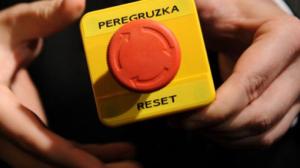 If I had to theoretically reverse-engineer this beast, the principal challenge becomes how to reconcile what could easily become a freeform exploration of chaos theory. Periodically, there seemed to be narrative inflection points, roughly occurring at the end of an “act” in theatrical parlance, although that ship sailed long ago. These moments temporarily aggregated all the players in a single room and forced various narrative threads into some form of interim resolution. Think of it as a metaphorical reset button that attempted to contain the rapidly spiraling madness.
 I give this team a ton of credit for creating this thing in the first place. I can imagine the B.S. sessions where people were saying, “What if we riffed on Plato’s Republic and inserted a bunch of characters from Greek mythology and rendered them against a German Expressionist backdrop and involved the audience, but totally let them feel like they were directing the action so that we’d basically be improvising 100% of the time so that each night we’d basically be putting on a new show.” Believe it or not, people have these kinds of crazy ideas fairly often. However, it’s a small handful who have the balls to actually follow through and try to raise the money, develop the concept, find the space, build the team, train the actors, build the set, and the hundred other things needed to bring this fully-grown Hydra to life.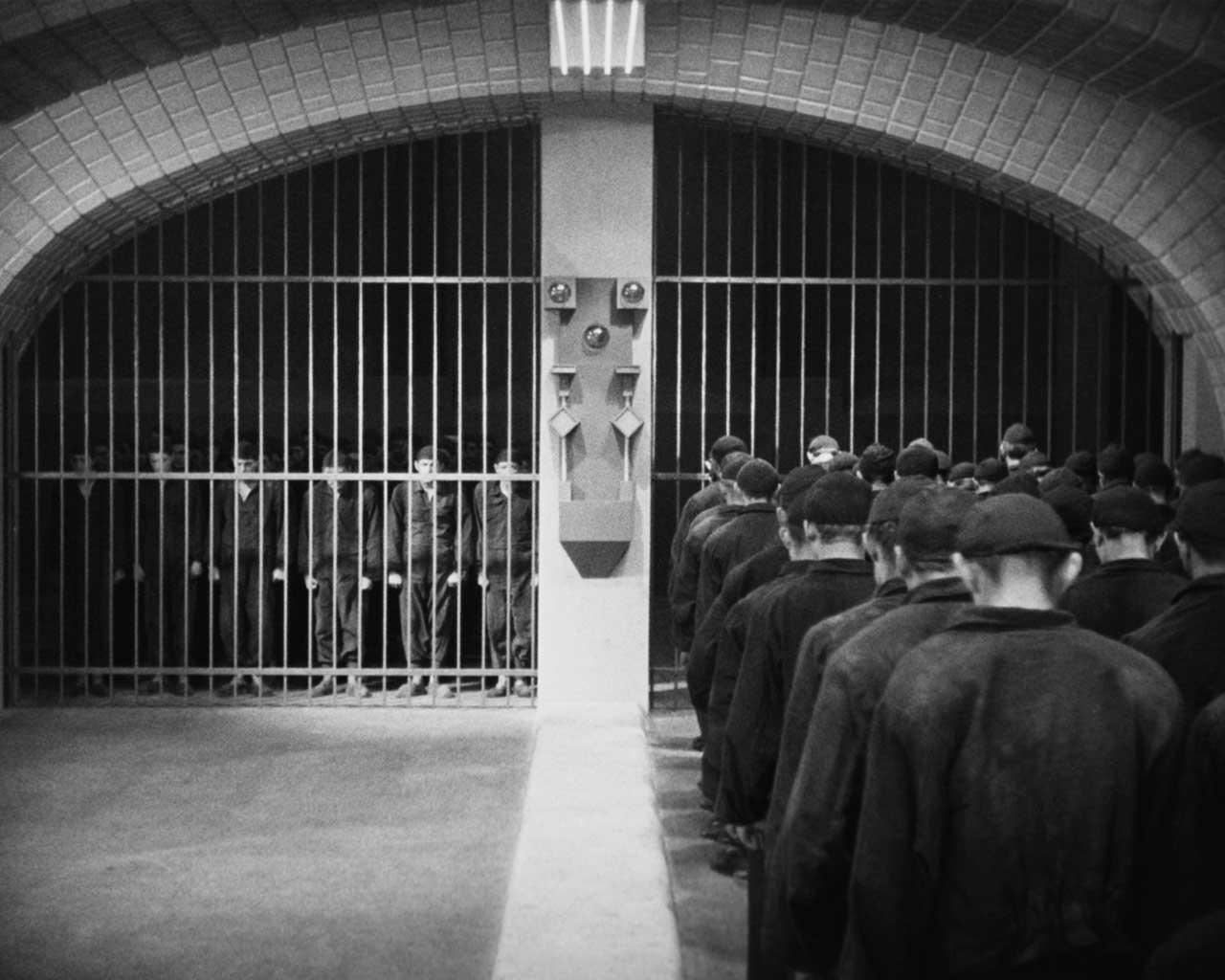
 “Dude, how did you score those tickets?!”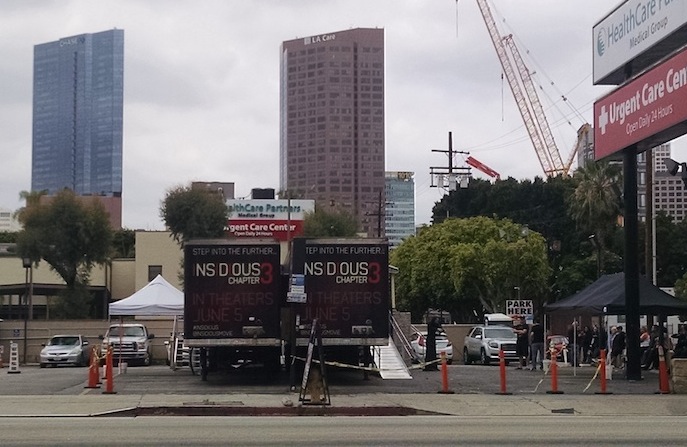
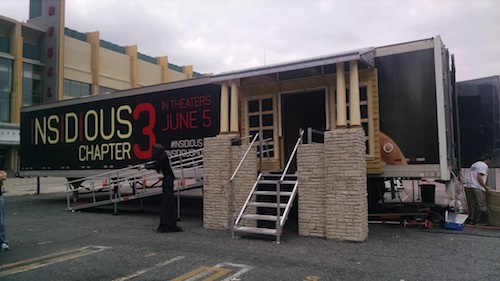
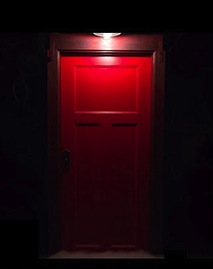 The tiny chamber was cramped, dimly lit, and filled with all kinds of bric-a-brac that evoked the home-gone-wrong feel of the films. A monitor turned on and played a short video introducing the upcoming VR experience. A previously unseen door opened and another ghoulish and relatively sedate character beckoned me forward and into a chair facing a familiar red door. Seconds later, I was in the Rift, heading into the Further. Or so I thought.
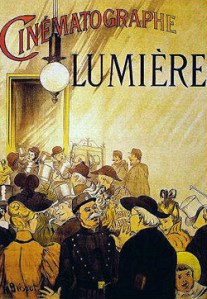 I recalled a story I heard in film school. About 120 years ago, a couple of brothers were trying to figure out something cool to do with their Cinématographe — one of the first devices to resemble a motion picture camera. One of the first pieces that they screened was a short clip of a train arriving at a station, evocatively titled, “Arrival of a Train.”
 A more fruitful daydream is that everybody in that room knew that they had just seen something that they’d never seen before, and that they felt like they could see that much further into what this new, crazy thing could be. And each of those early viewers might have got something out of it, talked about it with their friends who hadn’t seen it, forgotten it, or got hooked at the gills. Except they didn’t have blogs back then.
 “Are you ready to save the f–king world?” he asked. To be honest, it was a bit more than I had in mind after a day at work, but I exchanged looks with my companions and said, “Sure!” After all, what could possibly go wrong?
 So, back to saving the world. In the real world, we were at the Brewery Arts Complex, an artist colony housed in a former brewery that is off the beaten path in an industrial part of Los Angeles. It’s an easy place to get lost in and quite mysterious in its own right. Certainly worth saving.
 However, if you’ve read their website, you’re probably wondering, is this an escape room attraction? If you haven’t experienced one, escape rooms are pretty much what they sound like: you’re placed in a locked room and have to figure out how to get out, usually within a fixed time limit. And there’s no guarantee that you will. Getting out usually requires solving a number of puzzles based on objects in your environment, while possibly fending off antagonistic or distracting elements. I had a tremendous time at last year’s
  Story Room shares many of the game mechanics and sensibilities of an escape room, but the narrative framework substitutes progress for escape. It’s a subtle nuance, and therein lies all the difference.
 As a practical illustration: we did OK with the puzzles, but we were occasionally assisted via a mechanism that was integrated with the story. Sure, my ego would have been more gratified if we had performed better, but I found myself less focused on winning or losing and far more interested in what would happen next.
 The website boldly namechecks the Choose Your Own Adventure book series from the 80s & 90s. This type of branching narrative is a holy grail of sorts for experience designers in location-based entertainment, but can be operationally difficult to execute. It seems that on some level, even if we didn’t experience all the possible outcomes, they pulled it off.
 We were in there slightly over an hour, but time flies, as the saying goes. Understanding that like any production, they are limited by real resources such as budget and space, my main feedback for future productions would be to create more “scenes” even if each is shorter. Reflecting on how this show redraws the line between storytelling and problem-solving, I would love to see them take it even further and incorporate more branching, more rooms, and maybe even some live performers. In other words, more of everything that worked so well.
 Look around you. Where are you reading this right now? Chances are, you’re minutes away from an immersive, interactive experience that is waiting for you to discover it. Curious?
 Skeptically, I installed a
  We didn’t find what we were looking for, but we were undeterred, so for our second try, we chose a cache that seemed a bit easier. Each cache is ranked for difficulty and terrain, and contains a description and optional hints that guide you to the hidden location. We made our way to an unnoteworthy cluster of trees on a street corner that we would have otherwise driven past without giving a second look, however now it was imbued with mystery and potential. We descended upon it like a shoal of piranhas, discovered a camouflage canister hanging from a branch, and eagerly grabbed it, unscrewed the lid. The kids thrilled at the mysterious trove of miscellaneous knick-knacks within while we examined with curiosity the little notepad filled with messages from those who came before us. As we left our own impromptu scrawl for those who would in turn follow in our footsteps, we unwittingly jumped into the slipstream of a previously unknown world that was hidden in plain sight.
 The gentleman who stepped out introduced himself as papahog46, and told us that this was his cache. He just happened to be driving by, and he knew exactly what we were up to. I chatted with him a bit, and he said that he had recently come back from the Caribbean where he had left a few caches, and that he has also left a few in various places in Europe. The app allows you to log your finds, and leave a brief message, and he commented that many of the thank you notes he received were in other languages. After he left us to our meanderings, it occurred to me we had been having fun that he had made; transient explorers of a new world he created. We had been hanging out with the Game Maker!
 I finally started to realize that this thing was big. I used the app to see what was around my house: dozens, including one a block away. The neighborhood around my work: lousy with caches, including four in the park where I often eat lunch. A random place where I stopped for lunch on the way to San Diego: loads. I realized that geocaching is nothing short of a global phenomenon that has created a parallel universe bound together by a community that borders on a secret society. It has its own lingo, which I picked up on from reading the entries in the logbooks — kind of like a written secret handshake. In fact, geocachers have appropriated the word Muggle from the Harry Potter universe to designate a person who is not playing, a shorthand that happens to be pretty much spot-on.
 The Memelab