 The truth is, I only had a dim idea of where I was going or what to expect. A couple of days earlier, I received an email from “The Society” inviting me to observe some of its members engaging in their spiritual practices “within the hideaway of nature itself.” The email connected me to a short form, which among other questions asked if I would be available and bodily capable for a reasonably long hike early on Saturday morning. That Friday, I received a follow-up email with detailed instructions on where and when to show up, and what to do once I got there, noting that this particular time was unique to me, presumably to ensure a more reflective and individualized experience.
The show was called Babalon, and I was marginally familiar with The Society as a group that mounted some shows in LA’s dynamic immersive theater scene a couple of years ago, and was often mentioned along with other shows with a horror/haunted theme. However, as I’ve noted elsewhere, some of the techniques that have been refined in horror-themed shows have cross-pollinated into immersive shows across a variety of themes: small group or solo experiences, “secret” venues, personalized interactions with cast — all contributing an experiential intensity that may be unrelated to fear.
So there I was Saturday morning, packing a water bottle, an energy bar, applying sunscreen, and reviewing the pages of photo references and detailed instructions so that I could . . . go to a show.
The trailhead was busy; it was after all a beautiful summer morning in Los Angeles. I savored the dissonance of attending an event alongside a sizable group of people, who were actually not attending the same event as me, or at least I didn’t think they were. In fact, it was not possible to know with any certainty.
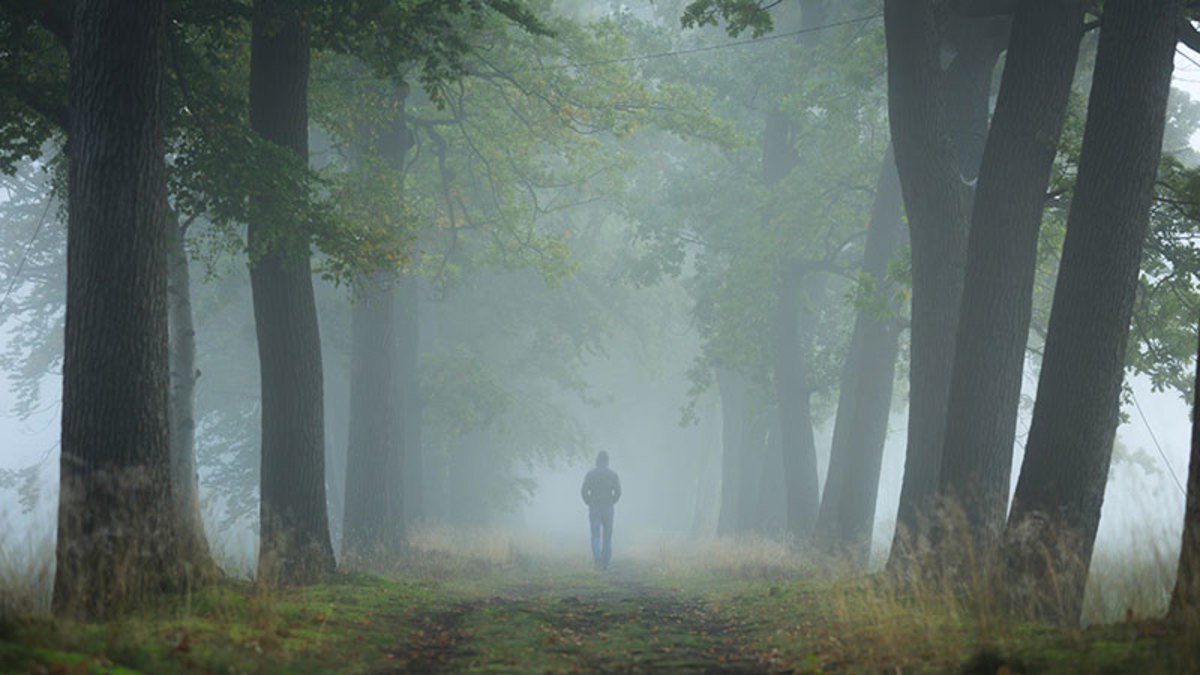 However, as is common with hiking trails, once my journey was underway, I soon found myself quite alone, save for the occasional courtesies to passed and passers-by. As I walked, I wondered: were they heading to/from my destination? Were they in the know? Initiated? Transformed? Enlightened? Before I knew it, without a single performer or setpiece that I could confidently identify, I was very much in a show that was possibly entirely in my own head.
The instructions advised that it would be about 2.5 miles and about 50 minutes to reach my destination. As I had committed the location of the trailhead to memory, I didn’t burden myself with any hard copies of the actual trail map. So, when I reached some unexpected forks in the path, I used my best judgment and hoped that I had chosen correctly — which seemed appropriately metaphorical for an experience about a group of seekers who have returned to nature to discover a more enlightened path.
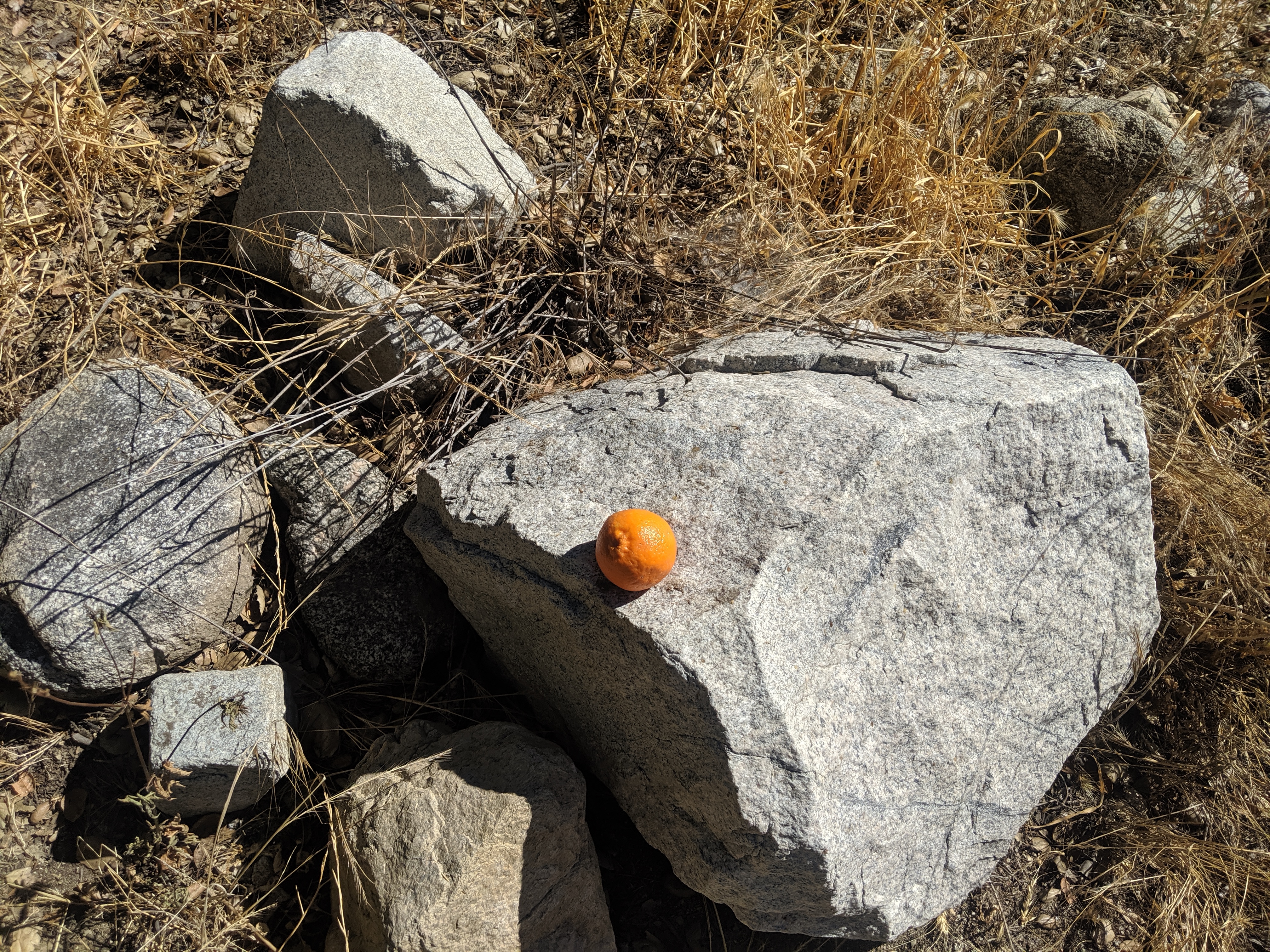 As I approached the destination about an hour later, it took me some time to locate the “guide” who I had been directed to find. She was quite literally off the beaten path, although in retrospect I realize that I had completely missed some subtle waypoint clues that had been hidden in plain sight. I had arrived, hot, sweaty, wondering if I had brought enough water, and with my curiosity and sense of accomplishment quite intact.
The first moments of any performance are critical. At this point, you and the show’s performers and creators must quickly reach an unspoken accord to suspend disbelief and go on a journey together. In immersive theater, the stakes can be even higher, because audience members need to literally enter the story and stay in it in order for it to work. It can be a big ask, and even the most willing of participants may “fall out” of the moment, or simply never fully arrive.
So it was a clever set-up that the guide presented herself as a down-to-earth, relatively grounded individual, who had left her unfulfilling corporate job to help The Society with their public image. It was a relatable, contemporary backstory that was a good fit for Los Angeles in 2019. It seemed entirely possible that I had actually been invited to a semi-clandestine gathering of an eccentric group in the middle of the woods, who had chosen to make a public display of their beliefs for all to see.
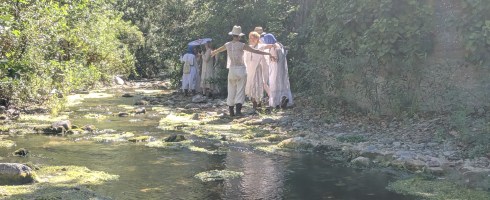
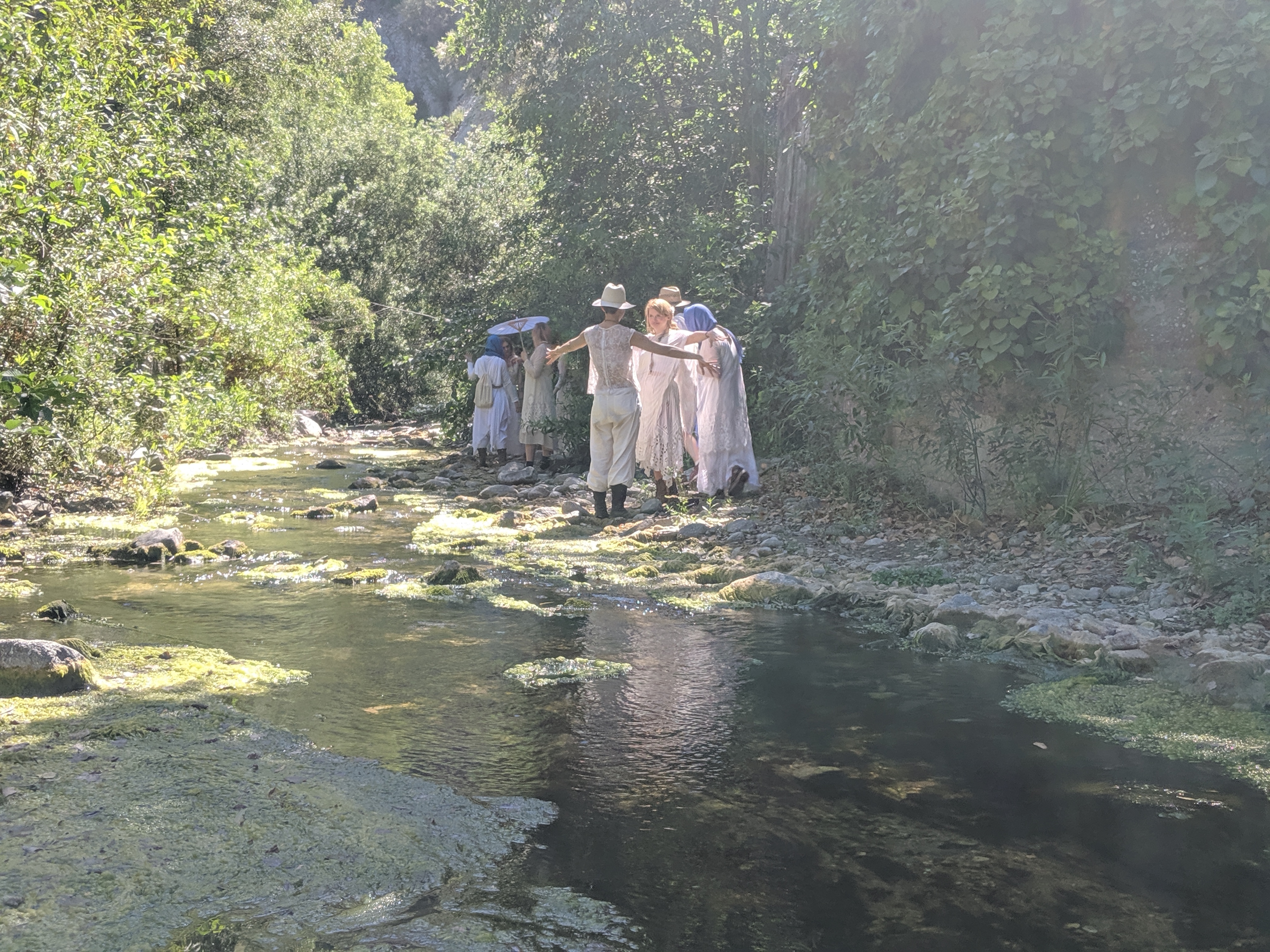 The guide shared some standard house rules: observe, don’t interfere, etc., and noted that I could stay and watch as long as I wanted from a variety of vantage points. What I found waiting for me was a group of women, frolicking in a creek-bed, consumed by a flow of hypnotic dancing and chanting, and dressed in airy attire that varied between ritualistic and fairylike. If you’ve ever seen the movie Picnic at Hanging Rock, a personal favorite (the original Peter Weir masterpiece, not the deplorable Amazon Prime debacle) then you’d have a decent approximation of what was unfolding.
I meandered and watched and listened and sought to tease out some sense or pattern to the endlessly unfolding ceremony. It was maybe more anthropology than theater, and with no clear start or finish, my eventual disengagement from any expectation of an outcome was its own reward. It was like a waking dream, an explosion of the sublime on the outskirts of the profane. When I had observed to my seeking soul’s content, I began the 2.5 mile journey back. Along the way, I had a lot of time to think about what I had done, seen, and was doing. The show was over (I think.) But I was still in the show.
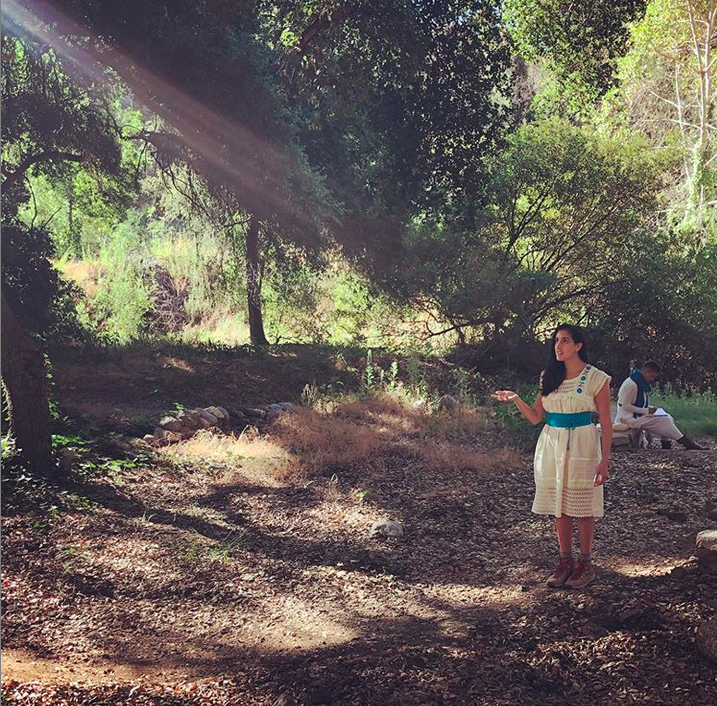 In addition to being intrigued by the potential of its storyline, I thought about how this show fit into the broader world of experience design. I reflected on the interplay between what had been directly produced as part of the show, what had been incidentally provided as part of the public location, and what I had personally brought to the experience. If I had merely seen the same “content” at a “normal” venue, would I have been affected as deeply? Of course the answer is no, and of course this isn’t news, because context differentiates themed entertainment and immersive theater from many other entertainment experiences.
Most immersive experiences, no matter how diverse, share a simple but common framework of:
- guest arrives
- show starts
- guest becomes part of the show
- show ends
- guest leaves
 This works really well for shows of all shapes and sizes, and in most cases, each of the bullet-points above, except for “the show,” are generally taken for granted. But Babalon exploded and blurred the lines between each of these phases. When did I really arrive? When did the show start? When did it end? This already sent my mind wandering in all kinds of wonderful directions, but what really struck me was how the five miles of walking factored into all of this, and how that might have been Babalon’s true stroke of brilliance.
Babalon embedded the actual show at the centerpoint of a hike: a meta-experience that served the functional requirement of providing access to the show, while also serving as a powerful metaphor for the theme of personal journey. It was the duration of the hike though that made me realize that merely attending the show required me to make a meaningful personal investment as a guest and unexpectedly enhanced the overall experience.
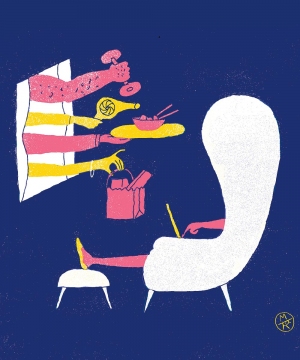 We increasingly live in an on-demand world, especially with regard to entertainment options. We can see, hear, listen, read almost anything we want, whenever we want, wherever we want. That was not the world I was born into, and I’m not that old. My kids may never know the thrill of scouring the imports bin at a music store for an elusive B-side. Or the triumph of finding that out-of-print novel at the 4th used book store visited that day. Or driving an extra ten miles to that one video rental store that has the trippy arthouse films. Even live entertainment has been similarly streamlined. No more camping outside the record store to be first in line to get a coveted concert ticket. You can call me a foolish romantic, but there are tracks, books, flicks, and tix in my past that mean all that much more to me because of what I needed to do to get them.
I don’t mourn the march of progress, but that doesn’t mean that I don’t celebrate the opportunities to slip between the cracks. As creators, we should not shy away from asking more from our audiences. And as audiences, we should be looking for ways to put more of ourselves into the shows. If a creator can inspire me to literally or figuratively go the extra mile, and if my effort translates to a more personally meaningful experience, then I’m ready to show up.

 It’s increasingly common to see “horror” experiences on nearly a year-round basis, but the best work tends to be saved for October. Amidst these high expectations and as a follow-up to last year’s debut, this year’s “signature” show did not disappoint, despite having scant resemblance to anything that had come before it.
 I can remember it so clearly. Parking my car on the unfamiliar suburban street near an address that I had only been provided in the past day. Walking alone up a dark path, carefully following the provided directions to choose the right path at appropriate landmarks, and finally approaching the figure wearing a black robe, standing silently. Waiting for me. And thinking to myself, “Now what?!”
 After Parturition‘s relatively disappointing follow-up to Fear‘s dark splendor, I was wary of Shoshin. From what scant information that was shared beforehand, it seemed to be an immersive theater show about Zen Buddhism. Huh? Exactly. Should I sit this one out? Have these guys gone off the rails? Did I have them all wrong? Was Fear a lucky hit? But it was May; October was months away, and I could hear the darkness calling.
 First, some overall context. Los Angeles continues to be one of the best places to experience what can be loosely described as extreme haunted attractions. Unlike traditional haunted houses which are designed to accommodate hundreds if not thousands of guests per hour, these experiences are designed for smaller groups, and sometimes just individuals. They frequently require you to sign a personal liability waiver that allows them to break down traditional barriers by permitting them to touch you and generally subject you to more bodily intense treatment than would ever be allowed at most theme park events or family-friendly/amateur offerings. I’ve written about some of them before, and when they’re executed well, they can be uniquely thrilling and impactful experiences. I’m not going to beat around the bush,
  5. Parturition (January 2016)
 4. Bardo Thodol (September 2016)
 “Dude, how did you score those tickets?!”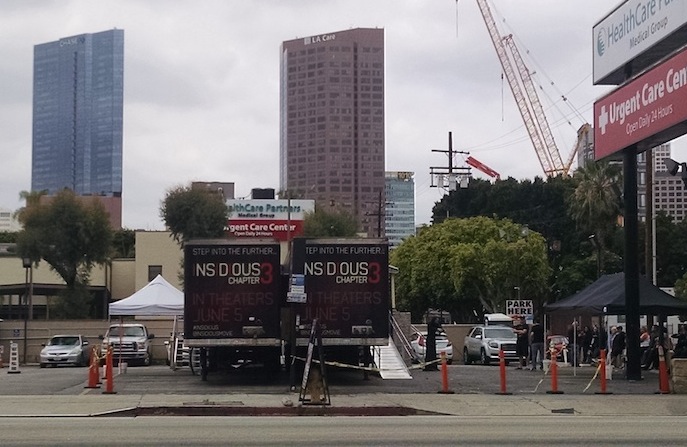
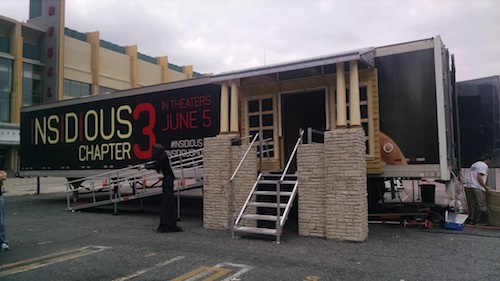
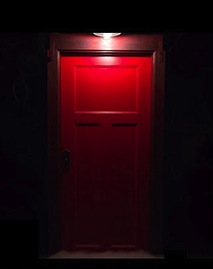 The tiny chamber was cramped, dimly lit, and filled with all kinds of bric-a-brac that evoked the home-gone-wrong feel of the films. A monitor turned on and played a short video introducing the upcoming VR experience. A previously unseen door opened and another ghoulish and relatively sedate character beckoned me forward and into a chair facing a familiar red door. Seconds later, I was in the Rift, heading into the Further. Or so I thought.
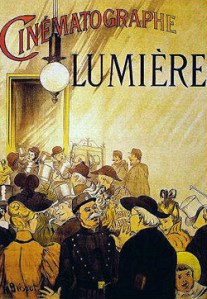 I recalled a story I heard in film school. About 120 years ago, a couple of brothers were trying to figure out something cool to do with their Cinématographe — one of the first devices to resemble a motion picture camera. One of the first pieces that they screened was a short clip of a train arriving at a station, evocatively titled, “Arrival of a Train.”
 A more fruitful daydream is that everybody in that room knew that they had just seen something that they’d never seen before, and that they felt like they could see that much further into what this new, crazy thing could be. And each of those early viewers might have got something out of it, talked about it with their friends who hadn’t seen it, forgotten it, or got hooked at the gills. Except they didn’t have blogs back then.
 When I heard that Wicked Lit featured plays being performed in a graveyard, I flashed back to those cringeworthy moments of my youth making short films in cemeteries, and thought, “This can go very wrong.” However, it was October, and I’ll try anything once if it involves Halloween. As we entered the venue, I had no way of knowing that I was about to experience my favorite show of a very busy season of haunted attractions.
 We were at the
  Our first offering was Dracula’s Guest, and we began by walking through the inner halls of the mausoleum that were spookily lit throughout, an impressive feat considering the myriad corridors and stairways through which we passed. The play started in what was probably the most tradtional “set” of the entire evening — a classic three-walled construction of a 19th century inn. We were soon introduced to Jonathan Harker of Dracula fame, and noted the presence of silver bullets and other familiar trappings of nocturnal menaces. But as quickly as they arrived, these ephemeral wisps of familiar milieu were dissipated by the winds of a brisker, edgier narrative. Harker’s archetypal naiveté is warped by a fierce insolence and (dare I say, millennial) sense of entitlement that made me wonder whether he might actually be better off with a couple of fangs in his neck. We were whisked outside the mausoleum to witness Harker’s journey through the Carpathians, before trekking to the final scene in a vast graveyard that was expansively tricked out with dramatic lighting and immersive sound effects. There, we watched a fierce and decidedly risqué encounter between Harker and two of the Count’s comelier devotees, before returning to the courtyard for our next adventure.
 The second play was The Monk, and it took place in Inquisition-era Venice. In this story, the familiar anchor was that of a Faustian bargain, but with a modern feminist twist. Our heroine was a young woman who, through an unexpected set of circumstances, finds that the pension that has been supporting her studies has been absorbed by the Church. Without this support, as a woman with academic ambitions in 17th century Europe, she finds herself with no option except to join a convent. She enters into a deal with a satanic figure to gain her freedom from society and the Church, but instead of bartering her soul, she must use her powers of seduction to ruin a man of the cloth. The deal itself, and its attendant hooded ghouls and wicked devil, was staged in the mortuary church, a delectably sinful nuance of the production. Finally, we watched the climactic crescendo play out below us in the mausoleum’s beautiful garden from the unique perspective of a balcony.
 The third play was Las Lloronas. Whereas the first two plays were clever dramatic narrative retellings, this piece was an impressionistic feast of story, dance, music, multimedia, and a succession of absolute knockout dramatic performances by every single one of the players. The gist of the narrative was the retelling of an Aztec legend in which a native of Tenochtitlan finds herself wed to Cortes, and subsequently driven mad by his betrayal to the point where she murders her children. The four scenes that followed depicted similar vignettes that showed how this tragic pattern repeated itself in successive generations and increasingly familiar and contemporary settings. While each vignette was hosted and narrated by a handsomely demonic figure, the emotional current of the story was conveyed through movement and passionate performances that embody the special power of the theatre. I felt very fortunate that through the luck of the draw, our group saw this piece last. It was definitely my favorite, and in its final moments, it sent the types of chills down my spine that I had been seeking (and not always finding) all month.
 he Purge last week. OK, that came out weird, let me explain.
 The typical haunted attraction tends to be a fairly linear affair. You start at the beginning and keep moving until you get to the end, trying to absorb or avoid (depending on your preference) as many scares as you can along the way. In contrast, Breakout is billed as “An Immersive Escape Experience.” Groups of up to six guests are locked into the attraction at one time and given thirty minutes to try to figure out how to get out by deciphering clues and solving puzzles that are embedded in the surroundings. The concept of an Escape Room attraction is not new, and did not originate as a horror-themed show, but as

 We solved a bunch of puzzles. We tried our hardest. We celebrated our successes. But in the end, we died. Murdered to be exact. Time ran out, and for us, it just wasn’t enough. If we had five more minutes! If we had only done such-and-such! Did we remember to look behind that one thing? We wallowed in the coulda-woulda-shouldas for a minute or two, but the general consensus from all of us was, “That was SUPER FUN!”
 I was in awe at how naturally we worked together as a team, despite the fact that we barely knew each other. People’s strengths immediately surfaced — the codebreakers, the searchers, the observers, the scouts — without any explicit coordination. Almost all of the puzzles required some form of cooperation, but it somehow happened in a seamless way. When it was all over with, we felt like old friends, and made plans to get together for future events once October rolls around. It was magical.
 Some people go to Hawaii on vacation to enjoy a little R&R in a beautiful setting. Others prefer a staycation where they can catch up on hobbies or just get back in touch with the simple pleasures of home. Me, I head down to LA for three successive nights of immersive horror theater. At least, that’s what I did in October.
 All you know about Blackout is: you need to sign a waiver before entering, it takes place in the dark, you must do as you’re told when prompted, there’s a safe word in case it gets too intense, and you must walk through alone. Is your imagination working yet? Mine was. From the moment I purchased the ticket, my mind was filled with questions. What the hell happens in there? What are they going to make me do? Does anyone use the safe word? Am I up for this? Can’t we just have a nice dinner somewhere and tell everybody we went?
 Fast forward about 30 minutes. I emerge, running, out of the dark, out of the building and onto the same sidewalk in downtown LA that I had lately and nervously ambled along on my way in. My eyes scan for something familiar; I see the people I befriended in line. I see my wife. We all breathlessly exchange snippets of experience, but it’s not really a time for words, and we all arrive at that conclusion at about the same time. I feel the crisply soothing autumn air on my skin now that I’m outdoors again. I’m soaking in the vibe of people milling on the fringes of this nondescript corner of downtown LA. I can hear and feel my heart beating; it seems to be returning to a more normal pace, but it’s not in a hurry. And neither is the rest of me. I’m alert. I’m aware of this strange, animal feeling where I can experience the world in five or more senses, and calmly it alights on my understanding. This feeling — it’s the feeling of being alive. Not the “oh my god that was so scary, I’m so glad to be alive” feeling. Quite the opposite: I realized that I hadn’t had that much fun in a long time.
 As we made our way through the city, back to the car, out in public, it became very clear that there was US and then there was everybody else around us. We moved through the crowds in this glowing bubble that only we could see. We just had this incredible experience that lit our brains on fire, and nobody else had any idea as they went about their evening. There was no judgment or condescension on our part, but we felt different and special. And that feeling was important and persisted for the rest of the night, and for several days afterward. In fact, I can still conjure that feeling and remember what it’s like to feel my senses rip into the texture of life, and for that I’m both grateful for the experience and inspired to create something that can have that kind of effect.
 Out of respect for the organizers, I won’t give up any spoilers, but I will share some general impressions. Admission can be purchased on a per attraction basis. I was here from California and was in the middle of nowhere, GA. I was going to all three.
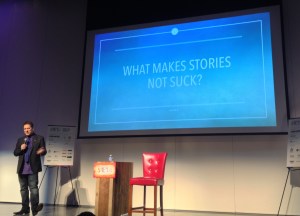

 In short, stories that do not have a deeply immersive component must suspend disbelief so that you can accept the story that is being told to you. On the other hand, immersive experiences must suspend disbelief so that you can accept the story that you end up telling yourself. This is a key insight for me as a storyteller. As a writer and filmmaker, I recognize that I often try to direct and control my audience’s reactions. For instance, I might evaluate the success of my piece based on how many people laugh or jump or cry at specific points that I have crafted. However, as an experience designer, that approach might not be ideal. A successfully designed experience may encourage a viewer to integrate what she is experiencing in a very personal way and with a highly individual outcome. To paraphrase Asa Kalama, another speaker at SATE’s story segment, sometimes the most effective approach in developing a successful experience may lie in providing a compelling framework for a guest’s creativity to blossom, and then getting out of the way!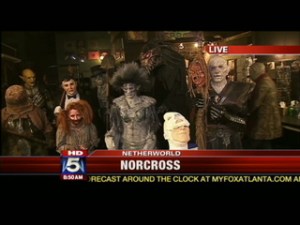
 The Memelab