Unfortunately, it couldn’t be all play, all the time in Atlanta. We had a full day of work ahead of us to set the record straight on a few items.
Does Octane deserve to be considered one of the nation’s best coffee establishments? Yes. Especially when paired with a popover from the adjoining Little Tart Bakeshop in the Grant Park location.
Will Rosebud provide a superlative experience for the discerning brunch enthusiast? We started with fried cheese grits with smoked cheddar and pepper jelly. Need I go on?
Can Porter Beer Bar live up to its reputation as one of Atlanta’s best destinations for enjoying a wide variety of amazing beer? Early results are extremely promising, but from a due diligence standpoint, we feel that it would be imprudent to end our investigation prematurely.

“Atlanta” is a flexible concept
Refreshed and recharged, and in gratitude to Atlanta’s gracious hospitality, we thought it was only right that we do our part to assist them with their zombie problem. Atlanta Zombie Apocalypse promises an interesting variant on the standard haunted attraction. Unlike NetherWorld, which was incongruously located a few blocks from suburban strip malls, AZA is convincingly nestled in the woods off a deserted stretch of highway. The attraction is built on and around the grounds of a deserted motel and it didn’t take much effort to believe that zombies might be nearby.
For those who don’t frequent this type of entertainment, the haunted attraction industry is all grown up and embraces more than what we endearingly referred to as a “haunted house” back in the day. There are a growing number of variants on the theme of scaring people for fun and profit, including haunted mazes, haunted trails, scare zones, haunted hayrides, etc. Many attractions aggregate and even mashup several of these styles to make sure that you don’t get too comfortable. AZA provides three attractions which can be generally described as 1) haunted house/haunted trail mashup, 2) haunted maze + paintball and 3) haunted house/immersive theatre.
 Out of respect for the organizers, I won’t give up any spoilers, but I will share some general impressions. Admission can be purchased on a per attraction basis. I was here from California and was in the middle of nowhere, GA. I was going to all three.
Although the attractions can be visited on a standalone basis, some of the employees had specific ideas on the order in which to experience them if you were seeing more than one. They were essentially imposing a meta-level of story and emotional engagement that hadn’t actually been accounted for in the overall design of the attraction. The best part is: different people had different opinions on the ideal order, and they were pretty passionate about their individual assessments. It was like having a personal team of horror sommeliers. More importantly, it was unscripted proof that the tendency to find story in our lives is central to the human experience. It also echoed my thoughts on the very personalized reactions that one can expect from immersive experiences.
Unlike many haunted attractions, which are essentially self-directed (i.e., here’s the entrance, proceed to the exit,) each of these attractions had a guided component. While the most memorable features of many attractions are the live performers, the level of interactivity is typically low and unidirectional: they scare, you scream, keep moving. The guides and performers at AZA added a sense of theatricality and interactivity which enhanced the the overall immersive quality of the experience. The first attraction we chose was called “The Curse,” and it took advantage of the ample, wild surroundings by using parts of the neighboring forest as the set. There was a backstory and a mystery to the attraction, and we were recruited as investigators and addressed directly by the guides and performers. Although I saw room for improvement, I was certainly entertained.
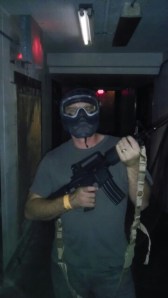
The blogger in the line of duty
For me, the main attraction, and the reason I found myself in Conley, GA deferring my important research of Atlanta’s brewpubs, was the “Zombie Shoot.” We were provided with a semi-automatic AirSoft gun (essentially paintball, but using specialized BBs instead of paintballs) and protective headgear, and were told, “Aim for the head or the chest. Keep firing until they go down.” Pretty much the exact opposite of your standard preshow advisement, “Keep your arms and legs inside the vehicle at all times.” Also, in case it’s not totally clear, you’re firing at real people, I mean zombies, not cardboard cut-outs or animatronics. Did it work? Mostly. Was it fun? Definitely.

Maybe Shakespeare actually IS the future of haunted attractions
The final attraction was called “?” and I think it’s telling that it might have been my favorite even though on its surface, it seemed to be a standard haunted house. Why? Story. It was the most theatrical of the three and featured the most interesting and inventive story, while still remaining focused on trying to scare you out of the building. Granted, we’re not talking Shakespeare, but it was a refreshing and successful variant on what could have been an uninspired production.
The production value in these attractions was not award-winning, and the storytelling was not expert, but I’m still glad I checked them out. It was all produced with a lot of heart, and everybody from the people selling the tickets to the performers and guides and zombies seemed to be having a good time and wanted to make sure that we were too. By providing three very different, hybridized attractions, it was clear that the creators were willing to take some risks and try out some new ideas, which will always impress me more than playing it safe.
Crossing the line from a one-way performance to an interactive experience can immediately raise many expectations that are potentially difficult to meet. The biggest challenge becomes the reconciliation between the audience’s sense of agency and the practical and aesthetic parameters of structured entertainment. It’s a tricky balancing act between living an experience and playing along. To choose an extreme yet practical example from this show, being provided with a gun and an opportunity to fend off assailants is real and pulls you right into the experience. However, remaining cognizant of where you can and can’t shoot can temporarily pull you out. It trades the steady equilibrium of an evenly immersive but passive experience for one which attempts to balance instances of deep immersion within a more structured rules-based framework. The resulting dynamics suggest a hybrid with gaming, sports, and other experiences that would otherwise seem at odds with what (in this case) is essentially theater. Personally, I think that finding a satisfying balance in these intersecting sensibilities is a challenge worth taking on, and that we’re hopefully just scratching the surface of the types of experiences we can expect to enjoy in the future.
Follow @thememelab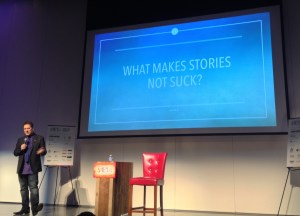


 In short, stories that do not have a deeply immersive component must suspend disbelief so that you can accept the story that is being told to you. On the other hand, immersive experiences must suspend disbelief so that you can accept the story that you end up telling yourself. This is a key insight for me as a storyteller. As a writer and filmmaker, I recognize that I often try to direct and control my audience’s reactions. For instance, I might evaluate the success of my piece based on how many people laugh or jump or cry at specific points that I have crafted. However, as an experience designer, that approach might not be ideal. A successfully designed experience may encourage a viewer to integrate what she is experiencing in a very personal way and with a highly individual outcome. To paraphrase Asa Kalama, another speaker at SATE’s story segment, sometimes the most effective approach in developing a successful experience may lie in providing a compelling framework for a guest’s creativity to blossom, and then getting out of the way!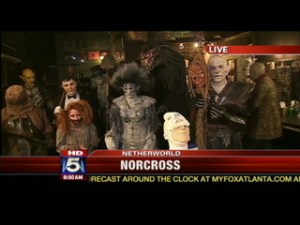
 Once I got home, I called the number and received further instructions on where to show up and what to say when I got there. The following evening, we left the nighttime streets of 21st Century San Francisco, walked through the doors of a nondescript building, right into the year 1923 and the world of The Speakeasy.
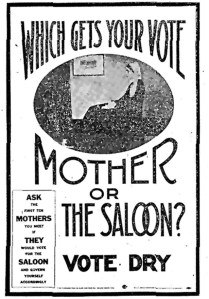 The Speakeasy will be a work of immersive theatre. Like many newly-minted terms in art, technology, culture, etc., it’s both challenging and somewhat pointless to attempt to concretely define immersive theatre because every new show seems to expand the scope of what it can encompass. Generally though, it refers to a theatrical experience which “breaks the fourth wall,” which is a fancy term for saying that the conceptual, invisible barrier that typically separates the audience from the players is understood to be nonexistent. In short, when you come to an immersive theatre show, you should expect to find yourself onstage. I am personally very interested in this concept, because it employs many of the storytelling sensibilities that are found in the world of themed entertainment and theme parks. If you think of a theme park as a giant work of immersive theatre, then you can start to get a sense of the exciting possibilities for both of these types of entertainment.

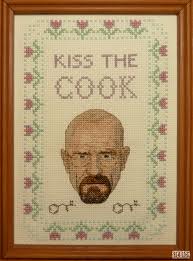 Let me just cut to the chase. Breaking Bad is an intense show. It has successfully navigated the murky waters of long-format television to create an epic story that has momentum and feels real without getting
  Before you write me off as a Luddite, (actually a pretty audacious proposition if you’ve read any of my other posts) I admit that the concept of second screen might have its place. I’m an unabashedly huge fan of


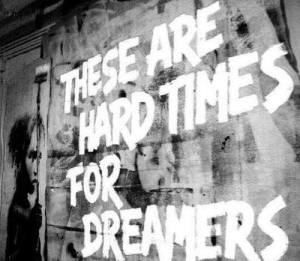 As I mentioned, I choose to interpret each character as a facet of a single conceptual main character, which I conceive as “the daring dreamer.” Each of these characters approaches their personal challenge from a different angle and has a different story to tell, but every single one of them shares a common drive to put it all on the line to realize their dream. Most are honest about the fact that they’re not looking past the here and now, and some even have the courage to admit that this may not even be a stepping-stone to anything except professional disappointment. But that doesn’t stop them from dreaming. I believe that the mirrors, which arguably constitute the one “prop” in the entire show, intentionally reflect the audience back to itself as if to say, “This is you onstage.” I believe that the reason why people lined up for 15 years to see this show is that every person who watches it finds at least one character that speaks for them and challenges them to ask themselves, “Where is that daring dreamer that once was?” I know I did. Even if that resonance exists for only a handful of minutes, as represented by a single character, that feeling of being “spoken to” is powerful. That said, there may be any number of reasons why none of these characters truly speak to you, and that is at the heart of the beauty and mystery of art. But if the very notion of the daring dreamer is a hollow concept, then you may as well cancel your insurance and pack it in, because chances are, you’re already dead.



 The Memelab