Archive by Author

Neurogaming Conference 2013: The Enchanting Prelude

13 Aug

For the purposes of this post, we’ll just pretend that “blog” is short for “backlog.” I attended the 1st Neurogaming Conference and Expo in San Francisco in May 2013, but chances are, you weren’t there, and you’ve never heard about Neurogaming, so we’re cool. By the way, I get a real kick out of the fact that this was the first incarnation of this event. This is one of the few instances where you can show up to the party early and have it be a good thing.

NO! This is not neurogaming!

NO! This is not neurogaming!

To start, I’m reminded of a comment that was made by one of the panelists on the “Investing in Neurogaming” panel. He basically said, “NEVER use the word Neurogaming with consumers.” This made me laugh out loud, because it explains the odd looks and slow backing-away when I mention the word to people. The conference actually touched on a number of interesting topics including medical/therapeutic and educational applications, and business/industry considerations in addition to “gaming.”

So, what does it mean exactly? Like any other recently-minted compound buzzword, the answer to that question is somewhat up-for-grabs, so I’ll take a hack at it. For me, neurogaming means the deliberate incorporation of emotional dynamics into the feedback loop of gameplay. Notice that I’m not talking about sensors or lidlocks or pharmaceuticals or mind control or anything like that. In fact, I’m deliberately taking a position that is not based in technology or biology, because it has helped me zero in on what fascinates me about it. I would go so far as to say that using my definition, arguably Neurogaming has been around for decades.

Have a seat = pwnd (literally)

Have a seat = pwnd (literally)

Take for instance (some of) the chess players that you see in a typical metropolitan park. Personally, I get spooked just walking by these guys, watching them move their pieces with efficient lethality before commandingly pummeling their timeclocks. If that doesn’t affect your game, then you should check your pulse.

People play games for any number of reasons, but some kind of emotional kick is almost always at the root of it. However, this dynamic potentially leads to a couple of dead ends.

The calm before the storm

The calm before the storm

First, games inherently require a level of abstract mental processing which competes with and interrupts the emotional experience. Unless you have a very vivid imagination, chess is still some funky-looking pieces on alternate-colored squares, and there’s probably a lot of ping-ponging going on inside your head that keeps you from developing an impractical level of emotional momentum. In fact, for certain games, it’s probably advisable to contain your emotions so that they don’t negatively impact your performance, in which case the emotional payoff is felt afterward. Second, despite the standard bluffs, threats, intimidation and occasional laughter that characterizes most gameplay chatter, there usually isn’t a method for any of this emotional energy to be utilized directly by the game itself. None of this is to suggest that emotions do not have a real effect on gameplay. Even a casual engagement with board games suggests that the opposite is true. However, my definition requires a “deliberate” as opposed to incidental incorporation of emotions. And what better means than technology to facilitate that; hence the conference.

Personally, looking at the trends, technologies, platforms, and prototypes that were discussed at the conference from a few steps back has allowed me to get a better grasp on their implications in other areas, including storytelling and experience design, regardless of whether an actual game is part of the equation.

What? You wanted to hear about the actual conference? I guess I got carried away. In the next post in this series, I share some stories and experiences from the event, including my highlights from the Expo where I attempt to plug my head into everything that I can.

AWE 2013 Highlights – Part 2: ChatPerf, Seebright, Hermaton

2 Aug

In Part 1 of my highlights from AWE 2013, I focused on the challenges that attend the quest for the holy grail of Augmented Reality: a wearable solution that provides a seamless experience. It’s a high-stakes game with a lot of heavy-hitting players and the outcome will potentially have significant impact on the high-tech sector, and possibly society in general. In this post though, I want to touch on some organizations that charmed me because they seemed to be doing things that nobody else was doing, yet still pushing the envelope and having a lot of fun doing it.

ChatPerf

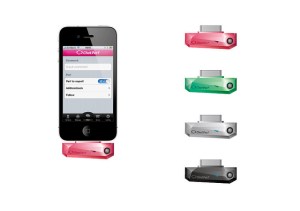
Scent never looked so good

ChatPerf: You can watch movies and listen to music on your phone. With haptics, your phone can even generate some useful, if rudimentary, tactile feedback. But smell things on your phone? Admit it, you’ve been waiting for it, and it’s here! I would have been happy to trade the sheer novelty of experiencing scent coming from a phone for a certain lack of polish in a product that still seems to be in the first-gen/preorder phase of its lifecycle. However, what charmed me most about ChatPerf is that they have already managed to make this product attractive and fun. It comes in different colors, and the overall aesthetic does not necessarily clash viciously with the well-considered design of the iPhone. You literally plug it into an iPhone, and then tap a button on the screen which causes the device to emit a fairly potent aromatic puff. Yes, you can literally see it puff! There is a Willy Wonka/steampunk aspect to it which is delightfully dissonant and unexpected. The developers at the booth told me that each unit is good for 200 blasts (trust me that’s more than enough) especially since each unit can only generate a single scent. However, they said that they are working on a single device that will generate 1000 different scents. Yeah, kind of stopped me dead in my tracks, too. Now that I’ve crossed that off my list, I’m hoping that there will be at least one lickable smartphone at AWE 2014.

Seebright Spark

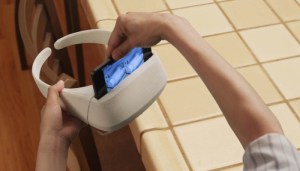
Has anyone seen my phone?

Seebright: As I’ve previously indicated, the Holy Grail won’t be found anytime soon. Personally, I think the folks at Innovega are on the right track, but that’s a whole other discussion. However, we clearly live in an age where we are essentially undaunted by the prospect of technical limitations, and when we want something, we want it now! At least, that’s what the folks at Seebright seem to be thinking. I hesitate to oversimplify what they’ve done, but I haven’t come across anybody else who is doing it, and it works, so here goes. The Spark is a piece of headgear into which you insert your phone, that uses optics to beam an image of the phone’s screen into your line of sight. Once you’ve played with AR long enough, you get to an apex of frustration where you want to take duct tape, an old watering can and a thick rubber band, and attach your phone to your head. Seebright feels your pain, but they put a lot of thought into it, and the Spark looks and works quite well, despite seeming to be a somewhat low-tech solution. It seems to be an intermediate step that may see itself made obsolete by the HUD that currently only exists in everyone’s dreams. However, so far we’re hearing a lot of talk without a lot of results, whereas the Spark makes you feel like we’re getting somewhere and tries to scratch that itch. I think that technology like this can facilitate prototyping of new experiences since they bridge a gap that is currently too wide, impractical or expensive to traverse from where we’re currently standing.

Hermaton

And you thought your dreams were weird

Hermaton: A central feature of AR, and one of the reasons why it has such a magic quality, is that there is no substitute for experiencing it firsthand. Nowhere is this more evident than with Hermaton from Darf Design. By definition, all AR requires a real-world object to serve as a “marker” to anchor one or more layers of virtual content. While this marker can be anything, it’s typically something 2-dimensional like a page in a magazine, or with the rapid development of computer-vision algorithms, a 3D object. In most cases, you’re dealing with an “average-sized” object, although there are some impressive examples of augmenting an entire building. However, Hermaton is basically a marker that you can walk inside that surrounds you. Words and pictures simply won’t do this justice. Even the marker, which was deployed as two full walls of a booth, is a compelling piece of abstract art. Hermaton succeeds as installation art, architectural statement, immersive game/story, and most importantly a satisfying experience. My experience walking through it was to temporarily lose myself in a novel form of exploration. There are interactive components on the environment, but they can be difficult to access, which requires you to slow down, absorb your surroundings, and enjoy the journey. It’s a powerful archetype for immersive storytelling, and I’m sure there will be followers and copycats. However, I can’t wait to see what’s next from this group.

Aeropress: The Art & Science of Perfect Coffee

26 Jul

If you don’t believe that coffee makes you a more productive, creative, attractive, interesting, and overall better person, then you may not find the rest of this post very interesting. I wouldn’t go so far as to call myself a coffee geek. True, I occasionally roast my own beans, and will sometimes indulge in the zen of a pour-over, but most days I can make my peace with Mr. Coffee if it comes out strong enough. But that all changed when the Aeropress entered my life.

Like broadband, mobile phones and DVRs, I’m finding it increasingly difficult to remember what the world was like before Aeropress. I vaguely recall a notion that there were two worlds of coffee: the one at home where I could make something well above functional, but acceptably short of sublime, and the other in the outside world of expensive espresso machines operated by artful barristas in some aromatic sacrosanctum. For less than $30, the Aeropress collapsed those worlds into two minutes of meditative perfection.

I should host this in my kitchen

I should host this in my kitchen

Coffee is a ritual. I know that I am not unique in the peace of mind that I experience in the particular and personal way in which I prepare, measure, grind, filter, and execute the first and most important cup of the day. But with almost every method, you must ultimately disconnect yourself and trust the machine, the process, or simply time itself. Once your water is heated and your beans are ground, you are less than one minute away from coffee, but the Aeropress requires you to become part of the process. Without rehashing the details of how the system works, which is more thoroughly described elsewhere, the Aeropress requires you to exercise equal parts patience, finesse, judgment, and care. In other words, it takes a bit of practice, but you feel a true sense of connection with your coffee. For what it’s worth, in my opinion, the properly-executed result is as good or better than what I can get in a cafe in the Bay Area, which is High Praise across the board. If you’re looking for a good bean, I’ve been pretty fixated on Highwire Espresso.

You’re probably wondering, what on earth does this have to do with Immersive Storytelling Technology? Well, I’m not going to lie to you, strictly speaking, nothing. However, it’s worth noting that the Aeropress is known as an immersion brewing method. While simple, it has enough science and technique behind it to qualify as technology. And as far as I’m concerned, after a cup of this stuff, I’m ready to jump into just about anything creative, including my favorite pursuit: storytelling.

AWE 2013 Highlights – Part 1: Epson Moverio

14 Jun

I made the journey from Oakland to Santa Clara to attend the Augmented World Expo (AWE 2013) last week, and enjoyed a day dedicated to the magic of Augmented Reality (AR). AR is a rapidly developing technology that has the potential to be a real game-changer in the development of immersive experiences and entertainment. There was a lot to absorb and discover and I will be sharing some of my personal highlights over the next few posts.

First some background. AR is hardly mainstream; it has only been deployed in a commercial context in the past few years. AWE is only in its 4th year, and the event has an electric air of excitement, novelty, and discovery to it. I attended it last year, and I was surprised and happy to see how much it had grown in terms of attendees and exhibitors since then. At last year’s event, I had been hoping to try a Heads-Up Display (HUD), which is basically a fancy term for futuristic eyewear that allows you to experience the world like Tony Stark or The Terminator.

Governator

As seen at AWE 2029.

The development of a high-quality, consumer-grade HUD is the type of holy grail achievement that would have a dramatic, transformative impact on the mainstream engagement with AR. In my opinion, as it’s currently conceived, Google Glass will not provide the type of game-changing, HUD-enabled AR that I am referring to. However, based on the attention that it’s getting, despite the fact that it’s not even for sale yet, it seems clear that this concept is captivating the public’s collective delight, or disgust, depending on your perspective.

To my recollection (and disappointment), there was not a single eyewear exhibitor at the 2012 event. This year though, an entire section of the expo was dedicated to eyewear and the topic of wearable computing was very hot. What a difference a year makes! I made a point of visiting every single eyewear booth, and attempting to try on every single product I could get my hands on. For pure entertainment potential and application, I was most impressed by the Epson Moverio.

Somehow, not that cool.

Epson Moverio BT-100: Not quite cool.

Don’t get off your horses just yet — this is not the grail, but it does seem like a step in the right direction. When you look at this image, remember: this represents the best effort from the marketing department of a multi-billion dollar, global corporation to make their product look cool. If they can’t pull it off, it’s probably not there yet. Does he look relaxed in that picture? Actually, he’s just rendered slightly immobile by the sheer weight of the glasses. OK, it’s not quite that bad, but it basically takes quite a bit of hardware to pull off what is otherwise a very impressive experience. The glasses project video content so that it looks like you’re watching a screen from a few feet away. The gear also natively supports 3D content without any additional enhancements or hardware. I could almost, almost look forward to a long airplane flight if I had this handy, which incidentally is probably one of Epson’s most compelling use-cases.

However, the glasses are essentially see-through, so that when you’re not watching any content, you can still see the world around you. Enter AR. Epson has been working closely with interested partners to support the integration of aftermarket components with some impressive results. Rig up a standard-issue webcam and load up a custom application on the Android-powered hardware that ships with the glasses, and you have a very compelling wearable AR solution. In fact, Scope Technologies was exhibiting alongside Epson and was demo’ing an impressive AR-driven training solution that was built on their “hacked” version of the Epson platform. Although I was only watching a monitor of what the glasses were projecting, and was not able to experience it myself, it was a promising glimpse of something real which I’d previously only thought of in conceptual terms.

In general though, this integration was a mess. Cables everywhere. 3rd party accessories mashed into each other and poking out at odd angles. A bit of showmanship and legerdemain to create the illusion of a seamless experience. One developer had to integrate an Android tablet into his setup to provide some missing functionality in the Epson-supplied box. The end result was . . . cosmetically challenged — about the furthest thing you could get from the elegance of an iPhone or the milligram design precision of Google Glass. However, there was a DIY sensibility to it that was driven by the fire of wanting to touch the future NOW, and not when some massive corporation hands it down to us from on high. I loved it!

In Part 2 of my posts about AWE 2013, I talk about some of the smaller exhibitors who are breaking exciting, new ground.

GeekDad

Raising Geek Generation 2.0

Haunting

The Home for Immersive Horror

This Week in Laundry

Immersive Storytelling Technology

Theme Park Insider

Immersive Storytelling Technology

InPark Magazine

Serving the themed entertainment community

imho

Sharing What I've Learned...of Creating Experience with Deep, Emotional Connection